Chevy Traverse Years to Avoid: A Comprehensive Guide
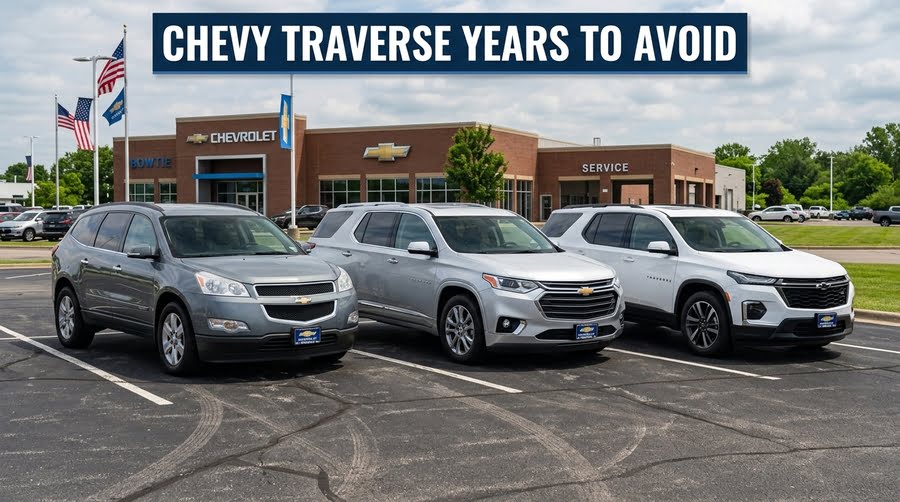
The Chevy Traverse years to avoid are 2009, 2010, 2011, 2012, 2014–2015 from the first generation, and 2018 from the second generation. These model years carry higher rates of engine failure, transmission problems, power steering loss, and electrical faults that lead to expensive repairs. Knowing which Chevrolet Traverse problem years to skip helps used buyers find a midsize SUV with a spacious third row, responsive handling, and a quiet interior without inheriting someone else’s mechanical headaches.
This guide covers generation-by-generation changes, the specific years flagged by owners and complaint databases, the mechanical problems behind each warning, safe model years to buy instead, used pricing expectations, and a pre-purchase checklist. The goal is practical: reduce the odds of a $3,000+ repair bill and put you in a Traverse that runs well for years.
Why Model Years Matter for the Chevy Traverse
Not all Chevrolet Traverse model years share the same mechanical DNA. GM (General Motors) made significant powertrain, platform, and electronic changes across generations. A 2010 Traverse and a 2020 Traverse share a name but little else under the hood.
Model year matters for 4 specific reasons:
- Powertrain reliability — Engine and transmission designs changed twice, and each change brought early-production faults that took 1–2 years to resolve.
- Recall exposure — Early-run models carry more safety campaigns. The National Highway Traffic Safety Administration (NHTSA) data shows complaint volume drops sharply after manufacturers apply fixes.
- Resale value — Years with documented problems depreciate faster, which makes a low sticker price tempting but hides repair risk.
- Parts availability — Older first-generation components become harder to source as the vehicle ages past 150,000 miles.
Buyers who understand generation breaks and production-year quirks avoid the worst Chevy Traverse years and land on models with proven track records. This single piece of knowledge separates a reliable family hauler from a money pit, similar to how understanding Honda CR-V years to avoid or Ford Explorer years to avoid saves buyers from costly mistakes with those models.
Chevy Traverse Generations and What Changed Over Time
Three distinct generations define the Traverse lineup. Each brought a different engine, transmission, and electronics package — and each introduced new failure patterns during early production.
First-Generation Overview (2009-2017)
The first-generation Chevrolet Traverse launched on GM’s Lambda platform, shared with the GMC Acadia and Buick Enclave. It used a 3.6L V6 paired with a 6-speed automatic transmission across most of its run.
Key first-generation facts:
- Engine: 3.6L Direct Injection V6 producing 281–288 hp depending on year
- Transmission: 6-speed automatic (GM 6T75)
- Seating: Up to 8 passengers with a usable third row
- Mid-cycle refresh: 2013 brought exterior styling updates, revised interior trim, and some mechanical improvements
The 3.6L V6 and 6-speed combo explains most of the reliability complaints in this generation. Timing chain stretch, excessive oil consumption, and wave clutch plate failure inside the transmission account for the bulk of high-dollar repairs.
Second-Generation Changes (2018-2024)
The 2018 redesign brought a new body, revised 3.6L V6, and a 9-speed automatic transmission. The platform changed, the wheelbase grew, and interior tech jumped forward significantly.
Second-generation improvements:
- Transmission: 9-speed automatic replaced the problematic 6-speed
- Weight reduction: Approximately 300 pounds (136 kg) lighter than the outgoing model
- Safety tech: Forward collision alert, lane keep assist, and rear cross traffic alert became available
- Rare option: A turbocharged 2.0L four-cylinder appeared briefly on the RS trim
The 2018 debut year carried typical first-run problems — transmission calibration issues, electrical glitches, and the well-known “Shift to Park” fault. By 2019, many of these were resolved through software updates and production changes.
Third-Generation Highlights (2025+)
The third generation arrived for the 2024 model year (as a 2025 model) with a turbocharged 2.5L four-cylinder replacing the V6. An 8-speed automatic handles shifting duties.
- Engine: 2.5L turbo-four producing 328 hp and 326 lb-ft of torque
- Cargo volume: Up to 98 cubic feet with seats folded
- Technology: Google built-in, available Super Cruise hands-free driving
- Long-term data: Limited — too new for meaningful reliability conclusions
Buyers considering the newest generation should understand that long-term durability data does not yet exist for the 2.5L turbo engine. The proven V6 models from 2019–2023 remain safer bets for buyers who value known quantities.
Chevy Traverse Years to Avoid
The following model years attract the most consumer complaints, NHTSA investigations, and repair shop visits. Data from CarComplaints.com, Consumer Reports, and NHTSA complaint databases supports each recommendation.
First-Generation Model Years Most Often Flagged for Problems
2009: Why It Stands Out
The 2009 Traverse was the first model year — a launch vehicle with unproven components in real-world conditions. Transmission complaints dominate, with owners reporting shuddering, hard shifts, and complete transmission failure around 80k+ miles. Many drivers paid $3,000 or more for transmission rebuilds or wave clutch plate replacement.
The 2009 also saw early timing chain stretch on the 3.6L V6, triggering check engine lights and rough running that preceded expensive engine work.
2010: Risky Choice
The 2010 model earned one of the highest complaint totals of any Traverse year on CarComplaints.com. Two problems define this year:
- Timing chain failure — Noise at cold start, intermittent check engine lights, and sudden power loss signal chain stretch or tensioner failure. Repair costs typically range from $2,743 to $3,583.
- Power steering failure — The system loses assist without warning, creating a direct safety hazard. A company-wide recall addressed some units, but not all owners completed the repair.
The 2010 also shows elevated rates of excessive oil consumption that can lead to bearing damage and bottom-end engine failure before 100,000 miles.
2011: Often Called the Worst
The 2011 Chevrolet Traverse carries the highest concentration of engine failure reports among all model years. Owners on forums and Reddit threads consistently call it the worst year.
Problems specific to 2011:
- Engine failure at average mileage around 90,000 miles, with replacement engine costs exceeding $5,000 before labor
- Power steering pump failure and noisy steering that worsens over time
- 2011 rear main seal leaks that allow oil to contaminate other components
- Reduced engine power warnings that put the vehicle into limp mode without warning
The 2011 Traverse is the year most commonly cited when owners discuss where most car crashes occur in the USA and mention mechanical failure as a contributing factor to loss of vehicle control.
2012: Avoid
The 2012 model shares the same pre-refresh platform as 2009–2011 and carries similar engine concerns. While timing chain complaints appear less frequently than in 2010, two other issues rise:
- 2012 alternator premature failure — Charging system problems cause no-start conditions and battery drains
- 2012 intake manifold gasket leaks that affect engine performance
- Electrical system failures — Radio malfunctions, A/C control module faults, and instrument cluster glitches
The 2012 Traverse sits in the same mechanical territory as the 2009–2011 models because Chevrolet did not introduce meaningful powertrain changes until the 2013 refresh.
2014-2015: Gray Area Years
These mid-cycle years improved over the 2009–2012 disaster zone but still carry specific concerns that warrant caution.
2014 problems:
- Intermittent power loss while driving — sudden torque drops that feel like limp-home mode activation
- 2014 timing chain tensioner wear that creates noise and potential engine damage
- 2014 coolant reservoir crack that leads to slow coolant loss and overheating risk
- Electrical quirks including fuel gauge jumps and StabiliTrak warnings
2015 problems:
- 2015 water pump issues that cause overheating around 50,000 miles
- A/C compressor failure requiring $1,200–$1,800 in repairs
- 2015 sunroof leak corrosion that damages headliner and electrical components
- Lower overall reliability scores from Consumer Reports compared to 2013 and 2016–2017
These years can work if full service records prove that known problem repairs were completed. Without documentation, they carry too much latent risk for a confident purchase.
Second-Generation Early-Year Warnings
2018: Early Reliability Issues
The 2018 Traverse marked a complete redesign — new platform, new transmission, updated electronics. First-year production vehicles from any manufacturer tend to have teething problems, and the 2018 Traverse delivered several:
- “Shift to Park” fault — The vehicle fails to recognize it is in Park, causing shutdown difficulties and repeated dashboard prompts
- Transmission hesitation — Delayed shifts, harsh engagement, and occasional limp-mode symptoms at relatively low mileage
- 2018 HVAC blend door actuator failure causing temperature control problems
- 2018 brake shudder recall affecting braking confidence
- Airbag-related recalls that require VIN verification and dealer service
The 2018 model often appears cheap on used listings precisely because the market has priced in these known defects. Buyers who understand what happens if you crash a leased car or deal with unexpected mechanical failure know that a low purchase price means nothing if repair bills erase the savings.
2019-2021: Notable Problems
The 2019 model improved significantly over 2018, but some issues persisted:
- 2019 infotainment screen glitch — Freezing, delayed response, and occasional blank screens
- 2019 brake booster failure on some units affecting pedal feel
- The “Shift to Park” issue continued on some 2019 production runs, though at lower rates
The 2020 model brought:
- Unusual brake noises reported at very low mileage — some owners heard grinding as early as 100 miles
- 2020 fuel injector clog concerns on some units
- A technical service bulletin (TSB) addressing brake noise for 2018–2020 Traverse models
The 2021 model showed:
- 2021 electrical system drain — Parasitic battery draws that kill the battery overnight
- Minor suspension noises on certain trims
- Fewer overall complaints than 2018–2020, making it a borderline recommendation rather than a firm “avoid”
What Makes These Years Worth Avoiding?
Understanding the mechanical failures behind each warning helps buyers recognize symptoms during a test drive and negotiate accordingly. These are the 8 most common problem categories across troubled Chevy Traverse model years.
Engine Troubles
Timing Chain and Tensioner Failure on Early 3.6L V6
The 3.6L V6 used in first-generation Traverse models has a complex timing chain drive with multiple chains, guides, and hydraulic tensioners. Premature chain stretch causes:
- Rattling noise at cold startup that fades as oil pressure builds
- Check engine light illumination with timing-related codes
- Rough idle and misfires as valve timing drifts out of specification
- Complete engine failure when a stretched chain jumps teeth
Repair cost for timing chain and gear-set replacement typically ranges from $2,743 to $3,583 including parts and labor. This repair requires significant engine disassembly and 8–12 hours of shop time.
The 2010 and 2014 model years show the highest timing chain complaint rates, though the issue appears across all first-generation years to varying degrees.
Excessive Oil Consumption and Cooling System Issues
First-generation Traverse models — particularly 2010 and 2011 — consume oil at rates far above normal. Owners report adding 1–2 quarts between changes, which signals piston ring wear or valve seal degradation.
Consequences of excessive oil consumption:
- Catalytic converter damage from oil burning in the exhaust
- Bearing wear from low oil levels between changes
- Bottom-end engine failure that requires complete engine replacement ($5,000+)
- 2015 water pump failures that compound cooling system stress
Cooling system leaks from water pumps, coolant reservoirs, and thermostat housings add to the problem. A sweet coolant smell, drips near the front of the engine, or rising temperature gauge under load signal cooling system distress.
Engine Concerns with the New Turbocharged 2.5L Four-Cylinder
The third-generation Traverse (2025+) replaced the V6 with a turbocharged 2.5L four-cylinder producing 328 hp and 326 lb-ft of torque. Owner reports mention:
- Throttle lag during initial acceleration
- A less refined engine feel compared to the outgoing V6
- Turbo-related heat management concerns (long-term data pending)
The 2.5L turbo is too new for definitive reliability conclusions. Buyers who want proven long-term durability should consider the 2021–2023 V6 models instead.
Transmission Issues
Six-Speed First-Gen vs Nine-Speed Second-Gen Teething
The first-generation 6-speed automatic (GM 6T75) shows:
- Shuddering during light-throttle acceleration
- Hard shifts between 2nd and 3rd gear
- Complete loss of 3rd, 5th, and reverse gears from a fractured wave plate
- Transmission fluid overheating during towing
Repair or rebuild costs for the 6-speed reach $3,000–$5,000+ depending on failure severity.
The second-generation 9-speed automatic brought improvement overall but had early calibration problems in 2018:
- Hesitation between gear changes
- Harsh downshifts during deceleration
- Occasional limp-mode activation requiring dealer recalibration
- 2016 torque converter shudder patterns that carried into early second-gen production
Transmission Fluid Leaks and Loss of Gears
Newer 2024–2025 models have documented transmission fluid leaks related to a factory torque bolt issue. While Chevrolet addresses these under warranty, used buyers who purchase these models out of warranty face repair costs for:
- Fluid line seepage at connection points
- Low fluid operation that accelerates internal wear
- Shifting inconsistencies that worsen over time without correction
Drivers wondering about financial exposure from mechanical failure should understand that car lease agreements come with stipulations about penalties that can compound repair costs on leased Traverse models with transmission problems.
Steering Issues
Power Steering Failure and Hard-to-Turn Steering
Power steering complaints concentrate heavily on 2010–2011 model years but appear across the first generation. Symptoms include:
- Sudden loss of power assist at any speed — the wheel becomes extremely heavy
- 2013 power steering pump noise and fluid leaks
- Intermittent assist that cuts in and out unpredictably
- Loose steering pump mounting that creates play in the system
Power steering rack replacement costs between $1,631 and $2,331 when fluid, alignment, and labor are included. This is both a financial burden and a direct safety concern — loss of steering assist while turning at intersection speeds can cause loss of vehicle control.
Brake System Issues
Unusual Brake Noises and Premature Wear
Some owners of the 2020 Chevy Traverse reported grinding noises from brakes at extremely low mileage — as early as 100 miles. Chevrolet issued a technical service bulletin (TSB) addressing this problem for 2018–2020 Traverse models.
Brake problems across model years include:
- Grinding or scraping sounds during normal braking
- Premature pad and rotor wear requiring replacement before 30,000 miles
- 2018 brake shudder recall affecting pedal feel and stopping confidence
- 2019 brake booster failure causing a hard or unresponsive pedal
Brake system failures matter beyond comfort — they directly affect stopping distance and collision avoidance. Data on car crashes in the United States resulting in high costs consistently identifies mechanical failure as a contributing factor in preventable accidents.
Electronic System and Driver Assistance Malfunctions
Second-generation Traverse models (2018+) added advanced driver assistance systems that introduced new failure modes:
- Infotainment screen freezing and delayed touch response
- Forward collision alert false activations
- Lane keep assist phantom corrections on straight roads
- 2019 infotainment screen glitch requiring dealer software reflash
- Backup camera intermittent black screens
These failures rarely strand you, but they erode confidence in safety systems and cost $200–$800 per dealer visit for diagnosis and software updates.
Suspension Wear and Noises
Higher-mileage Traverse models develop:
- Front strut noise over bumps (clunking or knocking)
- 2013 wheel bearing noise that worsens with speed
- Rear stabilizer bar link wear creating rattles on rough surfaces
- 2010 engine mount cracks that transmit vibration to the cabin
Suspension repairs individually cost $300–$800 per corner but accumulate quickly on vehicles past 80,000 miles.
Interior Quality and Seat Mechanism Problems
The third-row folding mechanism uses plastic components that wear over time:
- Seat-back latches that fail to lock or release properly
- Power seat motors that burn out on driver’s seats with frequent adjustment
- Second-row seat tracks that bind or rattle
- Dashboard trim pieces that creak or separate at seams
These issues affect daily livability rather than safety, but they indicate overall build quality and can reduce resale value.
A/C and Climate System Failures
Climate system problems appear across both generations:
- 2017 AC compressor problems — Complete compressor failure requiring $1,200–$1,800 in parts and labor
- 2018 HVAC blend door actuator clicking and failure to direct air properly
- Refrigerant leaks at evaporator cores (labor-intensive repair due to dashboard removal)
- 2015 A/C compressor failures clustered around 50,000 miles
For a family vehicle used in warm climates, A/C failure is not optional — it becomes an urgent, expensive repair that forces immediate action.
Safety and Recalls That Should Influence Which Year You Buy
Recall history provides objective data about design weaknesses. Key recall patterns by era:
First-generation recalls (2009–2017):
- Front seat-belt anchor cable detachment (2009–2014)
- Airbag inflator replacements (Takata-related)
- Liftgate strut failure causing unexpected hatch drops
- Power steering assist loss
Second-generation recalls (2018–2024):
- Shift cable breakage preventing proper gear selection
- Airbag module software faults
- Transmission fluid leaks from factory torque bolt issues
- Structural concerns on select production runs
Buyer action: Check every VIN against NHTSA recall databases before purchase. Refuse any vehicle with open safety recalls unless the seller agrees to complete repairs at a dealer before finalizing the sale.
Which Years Are Safe to Buy Used?
Based on complaint data from CarComplaints.com, Consumer Reports reliability ratings, and owner feedback on Edmunds, the following years represent the safest used Traverse purchases:
Best first-generation picks:
- 2013 — Benefited from the mid-cycle refresh; far fewer engine and transmission failures than 2009–2012
- 2016 — Apple CarPlay and Android Auto added; timing chain complaints drop significantly; available for $7,897–$10,761 depending on trim
- 2017 — End-of-generation refinement with the lowest complaint rate among first-gen models
Best second-generation picks:
- 2019 — Avoids the 2018 debut-year problems; 310 hp V6 with improved 9-speed calibration; available from approximately $15,954
- 2021 — 4.7 out of 5 average owner rating on Cars.com; lowest complaint volume among second-gen models; available from approximately $20,047
- 2022–2023 — Continued refinement with proven V6 reliability and mature software
Buyers cross-shopping other midsize SUVs should compare these recommendations against known issues with competitors. The Honda Pilot years to avoid carry different problems, and the Toyota RAV4 years to avoid present their own set of concerns — but each vehicle has specific model years that outperform others within the same nameplate.
Used Pricing, Mileage, and Value
Typical Price Bands and Why Low Prices May Hide Risk
Used Traverse pricing breaks into clear bands by generation and condition:
| Generation | Mileage Range | Typical Price | Risk Level |
|---|---|---|---|
| First-gen (2009–2012) | 100k–150k miles | $5,000–$10,000 | High — engine/transmission failure likely without records |
| First-gen (2013–2017) | 80k–120k miles | $8,000–$17,000 | Moderate — fewer systemic issues but age-related wear |
| Second-gen (2018) | 60k–90k miles | $15,000–$19,000 | Elevated — debut-year problems priced in |
| Second-gen (2019–2021) | 40k–80k miles | $18,000–$26,000 | Lower — proven reliability with maintenance |
| Second-gen (2022–2023) | 20k–50k miles | $25,000–$35,000 | Lowest — recent production, warranty may remain |
A Traverse priced well below market average for its year and mileage usually signals undisclosed problems or missing maintenance. The market is efficient — when a 2011 Traverse lists for $4,500, the seller likely knows about the timing chain rattle or transmission shudder.
For buyers considering car leases under $200 a month with no money down, understanding that a low monthly payment on an older Traverse can be offset by unexpected repair bills makes purchase math more realistic.
Mileage, Trims, and Drivetrain Impact Value
Mileage thresholds that matter:
- Under 60,000 miles — Most components still within normal wear life
- 60,000–100,000 miles — Timing chain, water pump, and transmission service become critical
- Over 100,000 miles — Budget for suspension, steering, and cooling system work regardless of model year
Trim levels and their effect on cost:
- LS/L — Base trims with lower purchase price and cheaper-to-repair features
- LT — Mid-range with better standard equipment; most common on the used market
- RS — Sport styling package; same mechanical underpinnings as LT
- Premier/High Country — Premium features that cost more to repair (adaptive suspension, premium audio, power-folding seats)
Drivetrain considerations:
- FWD (front-wheel drive) — Simpler, lighter, less expensive to maintain
- AWD (all-wheel drive) — Adds transfer case and rear differential maintenance; approximately $200–$400 more per year in service costs; better traction for northern climates
Fuel and Economy Expectations
Fuel economy varies by generation and drivetrain:
- First-gen V6 FWD: 17 city / 24 highway / 19 combined mpg
- First-gen V6 AWD: 16 city / 23 highway / 18 combined mpg
- Second-gen V6 FWD: 18 city / 27 highway / 21 combined mpg
- Second-gen V6 AWD: 17 city / 25 highway / 20 combined mpg
- Third-gen 2.5L turbo FWD: 22 city / 29 highway / 25 combined mpg (estimated)
- Third-gen 2.5L turbo AWD: 21 city / 28 highway / 24 combined mpg (estimated)
For a vehicle weighing over 4,300 pounds (1,950 kg) with seating for 8, these numbers fall within expected range for the midsize SUV class.
Pre-Purchase Checklist for a Used Chevy Traverse
Test-Drive and Warning Signs
A 20–30 minute test drive reveals most serious problems. Focus on these specific symptoms:
During cold start:
- Listen for timing chain rattle or ticking that fades after 30–60 seconds
- Watch for rough idle or misfires
- Note any check engine light illumination
During acceleration:
- Feel for transmission shudder between 25–45 mph at light throttle
- Check for hesitation or delayed shifts
- Monitor for reduced engine power warnings
During turning and parking:
- Test power steering at full lock in both directions
- Listen for power steering pump whine or groaning
- Check for intermittent assist loss
During braking:
- Listen for grinding or scraping at low speeds
- Feel for pulsation or shudder through the brake pedal
- Test emergency brake engagement and release
At shutdown:
- Confirm the vehicle recognizes Park immediately (no “Shift to Park” message)
- Restart after sitting 5 minutes to check for hot-start issues
- Verify all warning lights extinguish properly
Inspection Checklist
Before purchasing, confirm or inspect:
- Full oil change history with dates and mileage intervals
- Timing chain service records (mandatory for first-gen models over 80,000 miles)
- Transmission fluid condition — brown or burnt-smelling fluid indicates internal wear
- Coolant level and condition — milky oil or oily coolant signals head gasket failure
- A/C performance at idle and highway speed — listen for compressor clutch cycling
- All electrical systems — radio, backup camera, instrument cluster, power windows
- NHTSA VIN recall check with printed proof of completed campaigns
- Suspension inspection — bounce each corner and listen for clunks
- Tire wear pattern — uneven wear signals alignment or suspension problems
- Undercarriage inspection for oil leaks near timing cover, transmission pan, and steering rack
Repair Costs Drivers Should Expect
Budget expectations for common Traverse repairs help buyers evaluate whether a low purchase price truly saves money:
| Repair | Typical Cost Range | Common Model Years Affected |
|---|---|---|
| Timing chain and gear-set replacement | $2,743–$3,583 | 2009–2015 |
| Water pump replacement | $1,137–$1,673 | 2010–2015 |
| Transmission rebuild/replacement | $3,000–$5,500+ | 2009–2012, 2018 |
| Steering rack replacement | $1,631–$2,331 | 2010–2013 |
| Engine replacement | $5,000–$7,500+ | 2011 (most common around 90,000 miles) |
| A/C compressor replacement | $1,200–$1,800 | 2015, 2017 |
| Alternator replacement | $450–$750 | 2012 |
| Wheel bearing replacement | $350–$650 per side | 2013+ (higher mileage) |
| HVAC blend door actuator | $250–$500 | 2018–2020 |
| Power steering pump | $600–$1,100 | 2011–2013 |
A single major repair on a first-gen Traverse can exceed the vehicle’s market value. This reality is why automotive experts consistently recommend avoiding 2009–2012 models unless complete repair documentation exists.
Understanding repair cost exposure matters beyond the Traverse — drivers who experience mechanical failure while driving face situations documented in resources about what happens if someone else crashes your car or getting fired for crashing a company car when vehicle failures contribute to accidents.
How Extended Warranties Help Offset Frequent Repairs
GM’s factory warranty covers 3 years or 36,000 miles bumper-to-bumper and 5 years or 60,000 miles on the powertrain. Most used Traverse models on the market today have exceeded both thresholds, leaving owners fully responsible for repair costs.
An extended warranty or vehicle service contract makes financial sense for Traverse buyers in 3 situations:
- Purchasing a first-gen model (2013–2017) with 60,000–100,000 miles — Timing chain and transmission repairs remain possible; coverage for these components alone can justify the plan cost.
- Purchasing a 2018 model — Known transmission and electrical issues create unpredictable repair exposure.
- Planning to keep any Traverse past 100,000 miles — Component wear accelerates, and multiple systems may need attention within a short timeframe.
What to look for in a plan:
- Coverage that specifically lists timing chains, water pumps, and transmission hard parts
- Direct shop payment rather than reimbursement after out-of-pocket spending
- 24/7 roadside assistance for towing if a breakdown strands you
- Rental car reimbursement during multi-day repairs
- Transferability that adds resale value when selling
Cost vs. benefit math: A single timing chain repair ($2,743–$3,583) or transmission rebuild ($3,000–$5,500) exceeds the cost of most multi-year protection plans. Predictable monthly payments beat surprise four-figure bills for most family budgets.
Coverage remains valid only when owners follow the manufacturer’s recommended maintenance schedule. Keep records of every oil change, filter replacement, and scheduled service to ensure claim approval.
FAQs About Buying a Used Chevrolet Traverse
What years of the Chevrolet Traverse have engine and/or transmission problems?
The 2009–2012 model years have the most documented engine and transmission problems. The 3.6L V6 suffers from timing chain stretch and tensioner failure, while the 6-speed automatic transmission develops wave clutch plate fractures that eliminate 3rd, 5th, and reverse gears. The 2011 model year holds the highest engine failure complaint rate. The 2018 second-generation model also shows transmission calibration and engagement faults during its debut year.
What is considered high mileage for a Chevrolet Traverse?
High mileage for a Chevrolet Traverse starts at approximately 100,000 miles. First-generation models begin showing timing chain wear, power steering degradation, and suspension fatigue above this threshold. Second-generation models tolerate higher mileage better due to improved engineering, but still require proactive maintenance of transmission fluid, coolant, and brake components past 100,000 miles. Budget for $2,000–$4,000 in accumulated maintenance between 100,000 and 150,000 miles regardless of generation.
What other vehicles should I consider?
Alternatives to the Chevy Traverse in the midsize three-row SUV segment include:
- Honda Pilot — Generally higher reliability scores, though buyers should research Honda Pilot years to avoid for known weak points
- Toyota Highlander — Strong long-term durability, smaller cargo volume, less towing capacity
- Ford Explorer — Similar size and capability, with its own model years to avoid
- Kia Telluride — Modern tech and styling, limited long-term data due to recent introduction
- Hyundai Palisade — Spacious and well-equipped, relatively new nameplate
Each competitor has specific model years with documented problems. Cross-reference reliability data before purchasing any used three-row SUV.
Which model years have the most reported problems?
The 2010 and 2011 model years have the most reported problems across all complaint databases. The 2010 Traverse holds the highest total complaint count on CarComplaints.com, while the 2011 has the highest severity rating due to engine failure frequency. The 2009 and 2012 models rank third and fourth. Among second-generation models, the 2018 has the most reported issues.
Is the 2018 Traverse a year to worry about?
Yes, the 2018 Traverse carries elevated risk compared to later second-generation models. Specific concerns include the “Shift to Park” electronic fault, transmission hesitation and harsh shifting, airbag-related recalls, and HVAC blend door actuator failures. Complaint volume drops significantly for 2019 and later models as GM applied software updates and production fixes. A 2018 Traverse can work if the buyer verifies completed recalls, tests for shift engagement issues, and confirms dealer service records.
What are the most common mechanical problems across troubled model years?
Six mechanical problems account for most high-cost Traverse repairs:
- Timing chain and tensioner failure on 3.6L V6 engines ($2,743–$3,583)
- Transmission failure — wave plate fracture or calibration faults ($3,000–$5,500+)
- Power steering loss — pump or rack failure ($1,631–$2,331)
- Excessive oil consumption leading to engine damage ($5,000+ for replacement)
- A/C compressor failure ($1,200–$1,800)
- Water pump leaks causing overheating ($1,137–$1,673)
Which model years are generally considered the safest buys?
The safest Chevy Traverse model years are 2013, 2016, 2017, 2019, and 2021. The 2013 benefited from the mid-cycle refresh with fewer engine complaints. The 2016 and 2017 represent end-of-generation refinement with proven components. The 2019 avoids 2018 debut-year problems while offering modern features. The 2021 has one of the highest owner satisfaction ratings at 4.7 out of 5 on Cars.com.
How should a buyer inspect a used Traverse before purchasing?
Start with documentation, then perform a focused test drive and physical inspection. Demand oil change records, timing chain service history (first-gen), transmission service records, and printed proof of completed recalls via NHTSA VIN check. During the test drive, listen for cold-start rattle, feel for transmission shudder at 25–45 mph, test power steering at full lock, and verify “Park” recognition at shutdown. Physically inspect for oil leaks near the timing cover, check transmission fluid color and smell, test A/C at idle and highway speed, and examine tire wear patterns for suspension issues.
Can later second-generation models be trusted for long-term ownership?
Later second-generation models (2019–2023) show strong potential for long-term ownership when properly maintained. Complaint rates drop substantially compared to 2018, and the V6 plus 9-speed combination reaches maturity with improved calibration. Long-term success depends on following the maintenance schedule, particularly transmission fluid changes, cooling system service, and regular oil changes. The turbocharged four-cylinder in 2024+ models lacks enough service history for confident long-term predictions.
Are there specific trims or drivetrains that change reliability or ownership cost?
Drivetrain choice affects ownership cost more than trim level. AWD models add transfer case and rear differential service ($200–$400 annually) compared to FWD. Higher trims like Premier and High Country include adaptive suspension, power-folding seats, and premium electronics that cost more to repair. The RS trim adds sport styling without changing mechanical components. For reliability-focused buyers, an LT FWD model offers the best balance of features and manageable maintenance costs.
How do recall histories affect model-year rankings?
Model years with multiple safety recalls consistently rank lower in reliability ratings and resale value. The 2009–2014 first-generation models carry seat-belt anchor, airbag, and power steering recalls. The 2018 second-generation debut has airbag module and transmission-related campaigns. Fewer recalls correlate directly with higher owner satisfaction, lower long-term cost, and stronger resale prices. Always verify recall completion status before purchase — an unresolved safety recall affects both crash protection and potential liability.
Which years have the best resale values?
The 2021–2023 model years currently hold the strongest resale values due to modern features, proven reliability, lower complaint volumes, and remaining demand for the V6 powertrain. Among older models, the 2017 retains value better than other first-gen years because of its lower complaint rate and end-of-generation refinement. The 2025–2026 third-generation models will likely hold value well due to updated technology, but depreciation data is still developing.
How do used prices vary by model year?
Used Traverse prices vary by approximately $20,000+ across available model years:
- 2009–2012: $4,000–$9,000 (high risk, heavy depreciation)
- 2013–2015: $8,000–$14,000 (moderate risk, fair value with records)
- 2016–2017: $7,897–$12,000 (lower risk, good value)
- 2018: $15,000–$19,000 (elevated risk priced into discounts)
- 2019–2020: $15,954–$22,000 (reasonable risk-to-value ratio)
- 2021–2023: $20,047–$35,000 (lowest risk, highest cost)
Price alone should never drive the decision. A $6,000 Traverse that needs $4,000 in repairs costs more than a $9,000 Traverse with clean records and completed maintenance.
Conclusion
The Chevy Traverse years to avoid are 2009, 2010, 2011, 2012, and 2018 without question, with 2014–2015 requiring extra scrutiny before purchase. These worst Chevy Traverse years carry documented engine failure, transmission breakdown, power steering loss, and electrical problems that generate repair bills exceeding the vehicle’s value.
The safest years to buy — 2013, 2016, 2017, 2019, and 2021 — offer the same spacious third-row seating and family-friendly packaging without the mechanical landmines. Buyers who pair a good model year with documented maintenance, completed recalls, and a thorough pre-purchase inspection position themselves for reliable long-term ownership.
Three final steps before signing:
- Run a NHTSA VIN recall check and demand printed proof of completed campaigns
- Request full service records showing oil changes, transmission service, and any timing chain or steering work
- Schedule a pre-purchase inspection with an independent mechanic who can check for metal flakes in transmission fluid, coolant leaks near the timing cover, and oil residue on the bottom end
Choosing the right Traverse model year makes the difference between a dependable family SUV and repeated trips to the repair shop. The data exists — use it, and buy with confidence.