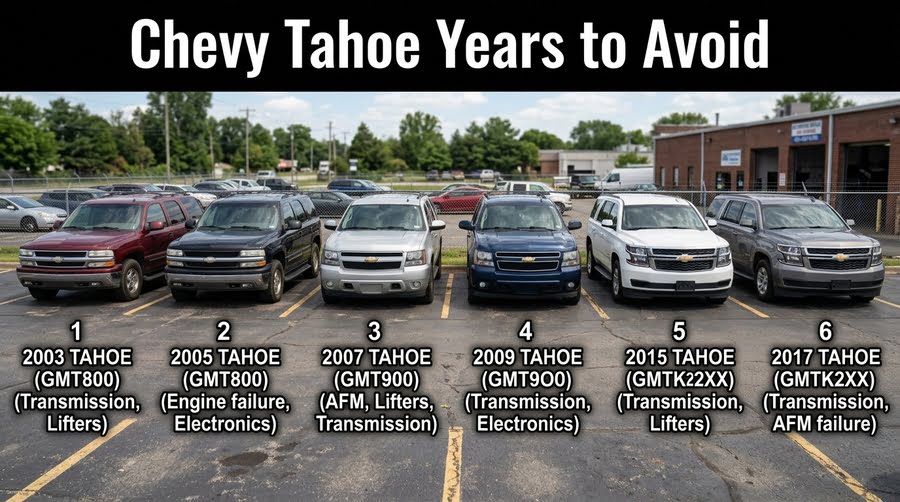
Chevy Tahoe Years to Avoid
The Chevrolet Tahoe years to avoid are 1999, 2004, 2005, 2007, 2008, 2009, and 2015. These 7 model years carry the highest complaint counts, the most severe engine and electrical failures, and the greatest probability of expensive repairs among all Tahoe production years since 1995.
The Chevrolet Tahoe, named after Lake Tahoe straddling California and Nevada, has been in production since 1994 as a full-size, truck-based SUV built by General Motors (GM). Most Tahoe model years deliver reliable performance and reach 200,000-300,000 miles (321,869-482,803 km) with proper maintenance. The problematic years share 4 recurring failure categories: engine defects including intake gasket failures and excessive oil consumption, interior accessory breakdowns like cracked dashboards and broken door locks, A/C system failures from refrigerant leaks and compressor collapse, and electrical issues producing warning messages and flashing lights.
This guide covers the specific Chevy Tahoe years to skip by generation, the common problems owners report across all model years, the safest Tahoe years to buy used, and current U.S. pricing and depreciation data for used buyers shopping in 2025.
Quick Answer: Avoid Chevrolet Tahoe Year Models 1999, 2004, 2005, 2007, 2008, 2009, and 2015
These 7 Chevrolet Tahoe model years show repeated failures across independent owner reports, recall databases, and reliability surveys. All 7 model years except 1999 share severe interior accessory defects including cracked dashboards, broken door locks, and flashing interior lights. Engine problems plague the 1999, 2004, 2007, 2008, and 2009 models with varying severity.
The worst overall Tahoe model year is 2007 based on complaint volume and repair severity. The 2015 model year is the worst from the fourth generation based on A/C failures, electrical glitches, and high recall count.
1999 — Engine Failures and Intake Gasket Trouble
The 1999 Chevy Tahoe is the most problematic first-generation model due to concentrated engine and intake gasket failures. Owners report 3 primary engine issues: intake gasket leaks that allow coolant and oil to mix, complete loss of power when climbing hills, and outright engine failures requiring full replacement.
A leaking intake gasket starts as a performance nuisance and escalates into a safety concern on grades. Repair costs for intake gasket replacement range from $800-$1,500, while full engine replacement runs $3,000-$5,500 depending on labor rates and parts sourcing.
Test-drive checks for a 1999 Tahoe: watch for rough idle, power loss during acceleration, coolant smell from the engine bay, and any temperature or check-engine warning lights. Walk away from any 1999 example without documented engine service history.
2004–2005 — Interior Defects and Gauge/System Glitches
The 2004 Chevy Tahoe and 2005 Chevy Tahoe share a cluster of interior and electrical defects that hurt daily usability and may fail state inspections. The 3 primary issues are cracked dashboards, faulty speedometers displaying incorrect readings, and erratic system warnings.
Cracked dashboards on 2004-2005 Tahoes are cosmetic but expensive to repair — dashboard replacement costs $1,500-$2,500 with labor. Speedometer failures create a safety issue since drivers cannot accurately gauge speed. Door lock actuators fail in these years, requiring $150-$300 per door for replacement.
Test-drive checks for 2004-2005 Tahoes: verify all gauges read correctly at idle and at speed, cycle each door lock multiple times listening for weak or absent actuator clicks, and test all climate controls and radio functions for intermittent operation.
2007–2009 — Oil Consumption, Low Oil Pressure, Costly Engine Fixes
The 2007 Chevy Tahoe, 2008 Chevy Tahoe, and 2009 Chevy Tahoe represent the highest-risk cluster among all Tahoe model years. These third-generation models equipped with the 5.3L V8 engine developed widespread excessive oil consumption and low oil pressure problems that led to catastrophic engine damage when unaddressed.
The 2007 Tahoe is the single worst model year in the entire Tahoe lineup based on complaint severity and volume. Owners report consuming 1-2 quarts (0.95-1.89 liters) of oil between changes, low oil pressure warnings appearing at highway speeds, and blue smoke from the exhaust indicating oil burning past worn piston rings.
Repair costs for 2007-2009 oil consumption issues range from $2,000-$4,500 for piston ring replacement to $5,000-$8,000+ for complete engine replacement. Low oil pressure left unaddressed destroys bearings and can seize the engine entirely. The Active Fuel Management (AFM) system — GM’s cylinder deactivation technology — is a contributing factor to oil consumption in these model years.
Test-drive checks for 2007-2009 Tahoes: check oil level on the dipstick before driving, drive for 15-20 minutes at highway speed, recheck oil level after the drive, watch for low oil pressure warnings on the dash, and look for blue smoke from the tailpipe during hard acceleration. Any example showing oil consumption signs requires engine work.
2015 — A/C Failures, Electrical Issues, and High Recall Volume
The 2015 Chevy Tahoe is the only fourth-generation model that belongs on the avoid list. GM introduced new electrical architecture for the 2015 redesign, and manufacturing teething issues produced a spike in 3 problem categories: A/C system collapse near 50,000 miles (80,467 km), climate control glitches from wiring faults, and a high volume of safety recalls.
A/C compressor failure on the 2015 Tahoe costs approximately $1,000-$1,800 to repair. The high probability of A/C failure combined with flashing interior lights, infotainment glitches, and multiple recall campaigns makes the 2015 a high-hassle ownership experience. Later fourth-generation models (2016-2020) received technical updates that corrected these faults.
Test-drive checks for a 2015 Tahoe: run the A/C at maximum cool for at least 10 minutes and verify consistent cold air output, watch for stray warning messages or flickering lights, and check the VIN against the NHTSA recall database to confirm all recall repairs are completed. Pass on any 2015 example with open recalls or documented A/C work.
Deep Dive on the Worst Tahoe Years by Generation
Examining each Chevrolet Tahoe generation clarifies which model year clusters present true systemic problems versus isolated one-off lemons. This generation-by-generation breakdown helps used buyers judge risk by design era and focus inspections on the correct failure points.
First Generation Red Flags (1995–2000)
The first-generation Chevrolet Tahoe (1995-2000) shows low overall complaint volume across most model years. The 1995, 1996, 1997, and 1998 Chevy Tahoe models are reliable with few reported issues — these years represent some of the safest older Tahoe purchases available.
The 1999 model year is the exception. Concentrated engine and intake gasket failures in the 1999 Tahoe point to a specific manufacturing defect rather than normal age-related wear. This makes the failure pattern predictable and the 1999 year avoidable with confidence.
Any first-generation Tahoe now carries 25+ years of age. Rust-prone frames, deteriorated rubber components (hoses, bushings, seals), and deferred maintenance are universal concerns regardless of model year. Demand service records and a compression test for any first-generation example, especially the 1999.
Second Generation Trouble Spot (2000–2006)
The second-generation Chevrolet Tahoe (2000-2006) improved comfort, interior space, and drivetrain longevity over the first generation. Most model years in this range — the 2000, 2001, 2002, 2003, and 2006 Chevy Tahoe — perform well with minimal systemic issues.
The 2004 and 2005 model years draw the highest complaint counts within this generation for electrical and interior failures. Cracked dashboards, gauge cluster malfunctions, and accessory electrical issues repeat across many owner reports for these 2 years specifically.
Minor issues exist in otherwise safe years: the 2001 Tahoe occasionally develops a broken rear window hinge after 90,000 miles, and the 2002 Tahoe may develop a knocking noise from the steering column when turning after 60,000 miles — a repair costing less than $300. The 2003 Tahoe shows similar minor issues appearing around 90,000 miles with repairs under $1,000.
Focus inspections on gauges, wiring harness condition, and accessory operation when evaluating any 2004 or 2005 example. The Chevy Equinox experienced similar electrical-era growing pains during overlapping production years.
Third Generation Danger Zone (2007–2014)
The third-generation Chevrolet Tahoe (2007-2014) brought real interior upgrades, improved ride quality, and more standard features. The 5.3L V8 engine powering most third-generation Tahoes is capable of 200,000+ miles — but early production years introduced the AFM (Active Fuel Management) system that created oil consumption problems.
The 2007, 2008, and 2009 Chevy Tahoe models carry the highest failure rates in the entire third-generation run. AFM-related oil consumption, low oil pressure warnings, and eventual engine failure create the most expensive repair scenario a Tahoe owner can face.
Not every third-generation Tahoe is risky. The 2010, 2011, 2012, 2013, and 2014 Chevy Tahoe models show proven mid-run reliability with far fewer oil consumption reports. GM refined the AFM system and engine tolerances through production updates that reduced failure rates in later third-generation models.
The 2011 Tahoe has one widely reported defect — the cracked dashboard issue that affected many Tahoe generations — but complaint volume is low enough that the 2011 remains a generally safe purchase. The 2014 Tahoe earned a J.D. Power Quality & Reliability score of 83/100, placing it among the strongest years for buyer confidence.
Verify oil history, look for blue smoke, and check oil-pressure behavior before buying any 2007-2009 example. Models from 2010-2014 require standard inspection diligence but carry significantly lower systemic risk.
Fourth Generation Issues (2015–2020)
The fourth-generation Chevrolet Tahoe (2015-2020) introduced fold-flat third-row seats, updated infotainment systems, and improved towing technology. The 2015 model year stands alone as the problematic outlier in this generation.
The 2015 Tahoe’s combination of new electrical architecture, A/C system weaknesses, and high recall volume makes the 2015 the only fourth-generation year to skip. Multiple small issues compound into high-hassle ownership that erodes the vehicle’s value faster than comparable years.
The 2016, 2017, 2018, 2019, and 2020 Chevy Tahoe models received technical corrections and show far fewer complaints. Minor issues exist in these years — some owners report A/C systems not blowing cold enough and sticky brakes in the 2016 Tahoe — but repairs cost less than $1,000 and occurrence rates are low.
When a 2015 example appears at an attractive price, confirm all recall campaigns are completed through the VIN lookup, verify A/C operation thoroughly, and factor potential repair downtime into your ownership budget. The price discount on a 2015 rarely compensates for the higher repair probability compared to a 2016 or 2017 of similar mileage.
Common Chevrolet Tahoe Problems Owners Report
The Chevrolet Tahoe earns a RepairPal reliability rating of 3.5 out of 5.0, ranking 21st out of 26 in the midsize/full-size SUV category. This “slightly above average” rating means the Tahoe is capable of long service life but carries higher repair costs when failures do occur. There are 5 primary problem categories that repeat across multiple Tahoe generations.
Cracked Dashboard, Door Locks, and Interior Accessory Quality
Cracked dashboards are the single most reported cosmetic issue across all Chevrolet Tahoe generations. Dashboard cracking affects the 2004, 2005, 2007, 2008, 2009, 2011, and 2015 model years most frequently. The cracks are cosmetic but expensive — full dashboard replacement costs $1,500-$2,500 installed.
Door lock actuator failures produce weak clicking sounds, inconsistent locking behavior, or complete failure to lock/unlock individual doors. Replacement cost per door runs $150-$300 in parts and labor. Radio system malfunctions and infotainment freezes appear in 2004-2005 and 2015 models.
Inspection approach: run your hand across the full dashboard surface feeling for cracks or soft spots, cycle every door lock 5-6 times from both the key fob and interior switches, and test all radio/infotainment functions including Bluetooth and backup camera.
A/C System Not Blowing Cold and Climate Control Failures
A/C system failure affects Chevrolet Tahoe models across multiple generations with the 2015 year showing the highest failure rate near 50,000 miles. The 3 primary causes of Tahoe A/C failure are refrigerant leaks from deteriorated O-rings and seals, electrical issues in the climate control wiring, and A/C compressor failure.
A/C compressor replacement costs $800-$1,800 depending on the model year. Condenser replacement adds $500-$1,000. The 2016 Tahoe occasionally shows A/C systems not blowing cold enough but at a much lower frequency than the 2015.
Inspection approach: start the vehicle and run A/C at maximum cool for a minimum of 10 minutes, place your hand directly at the center dash vent and confirm cold output, listen for compressor engagement cycling (a click followed by slightly increased idle RPM), and watch for inconsistent fan speeds or temperature fluctuations. Accidents can damage A/C systems — understand what happens when someone crashes your vehicle and how that affects cooling system integrity.
Low Oil Pressure, Excessive Oil Consumption, and Check-Engine Warnings
Low oil pressure is the most dangerous reliability issue in the Chevrolet Tahoe lineup because low oil pressure causes catastrophic engine damage fast. The 2007, 2008, and 2009 Tahoes with the 5.3L V8 and AFM system show the highest rates of oil consumption, consuming 1-2 quarts (0.95-1.89 liters) between standard oil change intervals.
Low oil pressure warnings illuminate on the dashboard during highway driving. Continued driving with low oil pressure destroys main and rod bearings, scores cylinder walls, and can seize the engine. Engine replacement costs $5,000-$8,000+ installed.
The 1999 Tahoe suffers from a different oil-related problem: intake gasket failure allows oil and coolant to mix, contaminating both systems simultaneously.
Inspection approach: check oil level on the dipstick before any test drive (note the exact level), drive the vehicle 15-20 minutes including highway speed, recheck oil level after returning, watch the oil pressure gauge during the entire drive for drops or fluctuations, and look for blue-gray smoke from the exhaust under hard acceleration. Any measurable oil loss during a short test drive indicates a serious problem.
“Service 4WD” Messages and Transfer Case/Selector Switch Faults
The “Service 4WD” warning message has appeared across more than a dozen Chevrolet Tahoe model years. The 2 primary causes are a faulty 4WD selector switch on the dashboard and a failed transfer case encoder sensor that reports incorrect position data to the vehicle computer.
Selector switch replacement costs $200-$400. Transfer case encoder sensor replacement costs $300-$600. The message may appear intermittently or remain constant depending on the severity of the fault. A persistent “Service 4WD” message does not always mean the 4WD system is mechanically inoperable — but the warning must be diagnosed and repaired for reliable operation.
Inspection approach: shift the 4WD system through all modes (2HI, 4HI, 4LO) on a safe surface like gravel or wet pavement, confirm mechanical engagement in each mode by driving briefly, and note any delay, grinding, or warning messages during transitions. The GMC Sierra 1500 shares this transfer case platform with the Tahoe and experiences identical selector switch failures.
Brake and Steering Complaints
Brake and steering complaints in the Chevrolet Tahoe include brake pulsation from warped rotors, long pedal travel from worn brake pads or air in lines, steering pull during braking, and clunking noises from worn steering rack or suspension components.
The 2002 and 2003 Tahoes occasionally produce knocking noises from the steering column when turning — a repair costing $200-$300. The 2016 Tahoe shows “sticky brakes” in owner reports but at low frequency. Brake pad and rotor replacement on a Tahoe runs $400-$800 per axle. Steering rack replacement costs $800-$1,500 installed.
Inspection approach: perform a moderate-speed braking test (40 mph to stop) feeling for pulsation through the pedal and steering wheel, test braking in a straight line noting any pull to one side, turn the steering wheel fully lock-to-lock at low speed listening for clunks or binding, and check for vague or wandering steering feel at highway speed. Brake failures contribute to high crash costs across the United States — proper brake condition protects occupants and other drivers.
Chevrolet Tahoe Years That Are Generally Safe to Buy Used
A reliable used Chevrolet Tahoe exists in every generation. The key is targeting model years with low complaint counts, fewer systemic failures, and proven long-term durability. There are 3 groups of safe Tahoe purchases organized by era and budget.
Most Recommended Picks
The safest older Chevrolet Tahoe year models with the lowest complaint volumes and fewest recurring faults are:
- 1995 Chevrolet Tahoe — minimal complaints, basic and durable powertrain
- 1996 Chevrolet Tahoe — proven reliability with simple maintenance needs
- 1997 Chevrolet Tahoe — few reported issues across all systems
- 1998 Chevrolet Tahoe — consistent performance and low repair frequency
- 2000 Chevrolet Tahoe — improved second-generation comfort with strong reliability
- 2001 Chevrolet Tahoe — minor window hinge issue after 90,000 miles, otherwise solid
- 2002 Chevrolet Tahoe — occasional steering knock after 60,000 miles ($300 repair)
- 2003 Chevrolet Tahoe — issues appear late (90,000+ miles) and cost under $1,000
- 2006 Chevrolet Tahoe — low complaint volume, good value in today’s used market
These years suit budget-conscious buyers comfortable with basic older-truck maintenance. Expect potential rust concerns, worn suspension bushings, and age-related rubber deterioration on first-generation examples.
Best Later Picks with Fewer Complaints
For more modern comfort, safety features, and technology with lower surprise repair risk:
- 2010 Chevrolet Tahoe — proven mid-run reliability, refined AFM calibration
- 2011 Chevrolet Tahoe — occasional dashboard crack but low overall complaint volume
- 2012 Chevrolet Tahoe — strong owner satisfaction and few systemic issues
- 2013 Chevrolet Tahoe — consistent performance across reporting platforms
- 2014 Chevrolet Tahoe — J.D. Power score of 83/100, strong reliability marks
- 2016 Chevrolet Tahoe — technical corrections from 2015 issues, minor A/C and brake reports
- 2017 Chevrolet Tahoe — few complaints, updated systems from fourth-generation refinements
- 2018 Chevrolet Tahoe — continued reliability with modern convenience features
- 2019 Chevrolet Tahoe — low complaint volume and strong owner retention
- 2020 Chevrolet Tahoe — favorable J.D. Power marks, last of the fourth generation
The 2010-2014 range offers the best balance of price, remaining service life, and proven reliability for buyers seeking a full-size SUV. The Ford Explorer and Honda Pilot compete in this segment — both have their own model years to research before purchase.
When “Safe” Still Means Inspect
Condition beats calendar year on every used vehicle purchase. A well-rated model year can hide deferred maintenance, undisclosed accident damage, or worn components that create expensive surprises after purchase.
Inspection priorities for any “safe” Tahoe year:
- Pull a vehicle history report (Carfax or AutoCheck) confirming title status, accident records, and mileage consistency
- Verify all service records document regular oil changes, transmission service, and brake work
- Check belts, hoses, and coolant condition for age-related deterioration
- Inspect the frame and undercarriage for rust — especially on first and second-generation examples
- Run the VIN against the NHTSA recall database and confirm all campaigns are closed
Budget match reality: older safe picks (1995-2006) cost less upfront but may need suspension work, rust remediation, or rubber component replacement. Newer safe picks (2016-2020) cost $25,000-$45,000+ but carry lower short-term repair risk. An unlicensed or uninsured previous driver may have caused undisclosed damage — vehicle history reports catch most of these situations.
Buying Used: Mileage, Depreciation, and What You Should Pay in the US
Smart used Tahoe shopping targets the intersection where purchase price and remaining service life produce the best value. The Chevrolet Tahoe depreciates approximately 50% in the first 5 years of ownership, making 5-10 year old examples the strongest value purchases in the current U.S. market.
Depreciation Sweet Spot
Target a 5-10 year old Chevrolet Tahoe with under 75,000 miles (120,701 km) and full service records. This range captures the steepest depreciation curve while leaving 125,000-225,000 miles of potential remaining service life based on the Tahoe’s documented 200,000-300,000 mile longevity.
The Tahoe ranks 7th among SUVs and trucks for longest-lasting models according to iSeeCars data. This longevity makes higher-mileage examples viable purchases when documentation supports proper maintenance history. A 2016 Tahoe with 90,000 documented miles and full service records can represent better value than a 2018 with 45,000 miles and no maintenance documentation.
Price Ranges by Generation
Current U.S. used market pricing for Chevrolet Tahoe models:
- First generation (1995-2000): $3,000-$8,000 depending on condition and rust
- Second generation (2000-2006): $5,000-$14,000 depending on mileage and trim
- Third generation (2007-2014): $12,000-$25,000 for sub-100,000 mile examples
- Fourth generation (2015-2020) under 100,000 miles: $25,000-$45,000 depending on trim, 4WD configuration, and condition
- Fifth generation (2021-present) under 75,000 miles: $40,000-$75,000 depending on equipment and mileage
Price variables that swing value $3,000-$8,000 between similar examples: 4WD vs. RWD (4WD commands premium), LTZ/Premier trim vs. LS/LT, towing package inclusion, third-row seat condition, and documented maintenance versus unknown history.
Understanding lease agreement penalties helps buyers evaluate whether purchasing a used Tahoe outright offers better long-term value than leasing a new one — especially for high-mileage drivers who exceed standard lease allowances.
Longevity and Negotiation
The Chevrolet Tahoe reaches 200,000-300,000 miles with documented maintenance including regular oil changes, transmission service at 60,000-mile intervals, and timely replacement of wear items like brakes, belts, and hoses. Although the Tahoe runs for years without repairs, when failures do occur on this full-size SUV, repair costs tend to run higher than smaller vehicles due to part size and labor time.
Negotiation leverage comes from evidence, not emotion. Base your offer on 4 documented factors:
- Open recall status — unresolved recalls justify $500-$1,500 in price reduction
- Inspection findings — brake wear, tire condition, and fluid condition provide measurable deductions
- Service history gaps — missing maintenance records justify 10-15% below comparable listings with documentation
- Market comparison — check 5-10 similar listings in your area for average asking price and adjust based on condition differences
A pre-purchase inspection costs $100-$200 and frequently identifies $1,000-$3,000 in needed repairs that either reduce your purchase price or eliminate a bad buy entirely. The cost of a rental car while your Tahoe undergoes unexpected repairs far exceeds the cost of a thorough pre-purchase inspection.
Frequently Asked Questions: Used Chevy Tahoe Years to Avoid
Q: What are the Chevrolet Tahoe year models to avoid when buying used?
The Chevrolet Tahoe year models to avoid when buying used are 1999, 2004, 2005, 2007, 2008, 2009, and 2015. These 7 model years carry the highest complaint volumes, most severe engine and electrical defects, and greatest probability of expensive repairs among all Tahoe production years. The 2007 Tahoe is the worst overall based on complaint severity and repair cost data.
Q: What are the most common problems reported in the Chevrolet Tahoe years to avoid?
The most common problems reported in the Chevrolet Tahoe years to avoid are engine defects (intake gasket failures, excessive oil consumption, low oil pressure), interior accessory failures (cracked dashboards, broken door locks, flashing interior lights), A/C system collapse, and electrical glitches. Engine problems affect the 1999, 2004, 2007, 2008, and 2009 models. Interior defects appear in all 7 problematic years except 1999. A/C failure concentrates in the 2015 model year.
Q: What interior accessory issues are common in the problematic Chevrolet Tahoe years?
Cracked dashboards are the most frequently reported interior accessory issue in the problematic Chevrolet Tahoe years, followed by incorrect speedometer readings (2004-2005), flashing interior lights (2015), failing door lock actuators, and malfunctioning radio/infotainment systems. Dashboard replacement costs $1,500-$2,500 installed. Door lock actuator replacement costs $150-$300 per door. These issues affect daily usability and may cause vehicles to fail state inspection in some jurisdictions.
Q: What are some of the safest Chevrolet Tahoe year models to buy used?
The safest Chevrolet Tahoe year models to buy used are 1995-1998, 2000-2003, 2006, 2010-2014, and 2016-2020. These model years received the fewest owner complaints and show the lowest rates of systemic failure across engine, electrical, and climate control systems. The 2014 Tahoe earned a J.D. Power Quality & Reliability score of 83/100. The 2010-2014 range offers the best balance of price and proven reliability for most used buyers.
Q: Which model years should buyers be cautious about when shopping for a used Chevrolet Tahoe?
Buyers should exercise caution with the 1999, 2004-2005, 2007-2009, and 2015 Chevrolet Tahoe model years because these years show higher rates of engine problems, electrical and HVAC failures, oil consumption, and a larger volume of recalls and owner complaints compared with adjacent model years. The 2007 model year draws the most “avoid” recommendations across independent review platforms including CarComplaints (rated “Clunker”) and owner forums.
Q: What specific engine or oil issues affected the 2007–2009 Tahoe models?
The 2007-2009 Chevrolet Tahoe models with the 5.3L V8 engine developed excessive oil consumption (1-2 quarts between changes) and low oil pressure warnings linked to the Active Fuel Management (AFM) cylinder deactivation system and worn piston rings. Low oil pressure left unaddressed destroys main bearings and rod bearings, leading to catastrophic engine failure. Repair costs range from $2,000-$4,500 for piston ring work to $5,000-$8,000+ for complete engine replacement. Similar issues affected the Chevy Silverado sharing the same 5.3L powerplant.
Q: Why is 2015 often singled out as a problematic model year?
The 2015 Chevrolet Tahoe is singled out as problematic because GM introduced new electrical architecture for the fourth-generation redesign, and manufacturing teething issues produced a spike in A/C failures near 50,000 miles, infotainment glitches, and a higher recall count than any other fourth-generation year. Later model years (2016-2020) received technical corrections that resolved these first-year issues. A/C compressor repair on the 2015 costs approximately $1,000-$1,800, and the high likelihood of this failure combined with other electrical defects makes the 2015 a poor value compared to 2016+ examples.
Q: What are the most common interior and accessory complaints to check on a test drive?
The most common interior and accessory complaints to check on a Chevrolet Tahoe test drive are dashboard cracking (visual and tactile inspection), door lock actuator weakness (cycle locks 5-6 times), climate control inconsistency (run A/C at maximum cool for 10+ minutes), infotainment freezing or rebooting, and power window operation delays. These issues map to the most frequent owner complaints across problematic Tahoe model years and are detectable during a focused 20-30 minute evaluation.
Q: Which years are generally the safest choices if I want a reliable used SUV?
The safest Chevrolet Tahoe choices for a reliable used SUV are the 2010-2014 models for the best value-to-reliability balance, and 2016-2020 models for the most modern features with proven dependability. Early first-generation models (1995-1998) and the 2000-2003 second-generation models are safe but carry age-related maintenance needs including potential rust and worn suspension components. The Toyota RAV4 and Acura MDX offer alternatives in the used SUV market — each with distinct model years to research.
Q: How should I verify a used vehicle’s history and potential recall fixes?
Verify a used Chevrolet Tahoe’s history by requesting a vehicle history report (Carfax or AutoCheck) confirming title status, accident records, and mileage consistency, then check the VIN against the NHTSA recall database at nhtsa.gov/recalls to confirm all safety campaigns are completed. Request service invoices for major engine, transmission, and HVAC work performed at dealerships. GM’s Certified Pre-Owned (CPO) program vehicles undergo a 172-point inspection and reconditioning process — CPO Tahoes must be less than 6 years old with fewer than 75,000 miles and all safety recalls completed before sale. CPO models include a 6-year/100,000-mile powertrain limited warranty and 12-month/12,000-mile bumper-to-bumper limited warranty.
Q: What are key items for a pre‑purchase inspection specific to this full‑size SUV?
The key pre-purchase inspection items for a used Chevrolet Tahoe are engine oil level and condition (checking for consumption), transmission shift quality under load, transfer case and 4WD selector operation through all modes, brake pad thickness and rotor condition, steering rack play, suspension noise over bumps, and a diagnostic scan for stored fault codes. A professional pre-purchase inspection costs $100-$200 and should include undercarriage rust inspection (especially first and second-generation models), cooling system pressure test, and verification of all electrical accessories. Use inspection findings to adjust your purchase offer — documented issues provide $500-$3,000+ in legitimate negotiation leverage. Where most car crashes occur in the U.S. correlates with wear patterns on used vehicles from high-traffic areas, making service history verification even more relevant for urban-sourced examples.
Conclusion
The Chevrolet Tahoe years to avoid are 1999, 2004, 2005, 2007, 2008, 2009, and 2015 — these 7 model years carry the highest risk of expensive engine, electrical, and climate control failures among all Tahoe production years. The 2007 Chevy Tahoe is the single worst model year based on complaint volume and repair severity. The 2015 Chevy Tahoe is the worst fourth-generation year based on A/C system collapse, electrical glitches, and high recall count.
Safe Chevrolet Tahoe purchases exist in every generation: 1995-1998 for budget buyers comfortable with older maintenance, 2000-2003 and 2006 for second-generation value, 2010-2014 for the best price-to-reliability balance, and 2016-2020 for modern features with proven dependability. The Tahoe reaches 200,000-300,000 miles with documented maintenance and ranks 7th among SUVs for longevity.
Skip the problematic Tahoe model years, target the safe clusters, verify service history and recall completion through the VIN, and invest $100-$200 in a professional pre-purchase inspection before committing. The Brittany Johns car incident and other documented vehicle failures remind buyers that mechanical condition directly affects occupant safety — choosing the right model year and verifying vehicle condition protects your investment and your family.