What Is Actually in a Storm Car Listing: A Look at the Inventory
People imagine storm inventory as a junkyard. Rows of beaten, aging vehicles that nobody wanted, marked down because they were already at the end of the road. It is a reasonable assumption. It is also almost exactly backwards.
The composition of storm inventory is unusual, and it is unusual for a specific structural reason: hail does not select for old, worn-out cars. It selects for cars that were parked outside in a particular place on a particular afternoon. Understanding what that filter actually produces tells you more about the category than any amount of general advice about damaged vehicles.
The Filter Is Geography, Not Condition
Every other category of damaged car has a condition filter attached to it. Collision vehicles were driven badly or driven into something. Flood vehicles were parked in a low spot or driven through water. Mechanical total losses were neglected or unlucky. In each case, something about the car’s use or its owner contributed to how it ended up on the lot.
Hail has no such filter. A storm cell covers a few square miles and everything under it takes the same beating, without regard to age, mileage, condition, price, or how the owner treated it. The result is that storm inventory is a nearly random cross-section of whatever happened to be parked in that area, which is not what any other damaged-vehicle category gives you.
And what is parked outside in commercial quantities? Not old cars. New ones.
Dealer Lots Dominate the Supply
A private owner whose car gets dented usually keeps it. They file a claim, take the check, and drive the same dimpled car for years. Those vehicles rarely reach the market, and when they do, they trickle in one at a time.
Dealer lots are the opposite. Hundreds of unsold vehicles parked in tight rows under open sky, all owned by a business that cannot retail a dented car at a dented-car price without wrecking its own numbers. When a storm crosses an auto mall, the dealer’s insurer writes an estimate on every unit, and any vehicle where the dent work exceeds the threshold becomes a total loss and heads to auction.
That is the single largest source of what you will find at a hail damage auction. Not tired trade-ins. Current-model-year inventory that was for sale at full price the previous morning. Rental fleets, port and rail staging yards, and lease-return lots feed the same pipeline for the same reason: a lot of vehicles, in one place, with no cover, owned by an entity with no interest in retailing damaged goods.
The Age Profile Surprises People
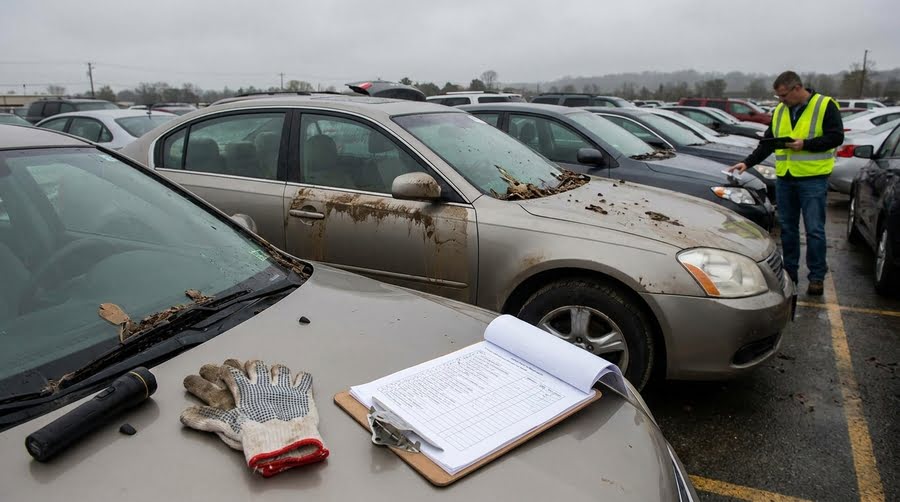
Look at a batch of storm listings from a recent event and the age distribution tells the story immediately. A large share are within a couple of model years of current. Many have four-digit odometers. Some have three-digit odometers, because they were delivered the week before and never sold.
This is the part that does not compute for buyers accustomed to salvage listings. A vehicle can be a declared total loss with 240 miles on it. Nothing about the car is used up. The tires are new, the fluids are factory-fill, the interior has never had a passenger, and the warranty question is the most interesting thing about it. It was simply parked in the wrong lot on the wrong afternoon, and an insurance formula did the rest.
Older vehicles do appear, of course. Private owners occasionally sell, small dealers total out aging stock, and some storm cars have a second history behind the dents. But the center of gravity in this inventory sits far younger than most people expect, and that is the opposite of every other damaged-vehicle category.
The Model Mix Reflects the Region, Not the Damage
Because the filter is geographic, the model mix in a batch tells you what sells in that region rather than what fails there.
A storm across the Texas panhandle produces pickups, because that is what those lots stock. A storm across a Denver auto mall produces all-wheel-drive crossovers. A storm through the middle of a metro area produces the same compact sedans and small crossovers that fill every commuter driveway nearby. If a dealer group specializes in one brand, a single storm can drop dozens of that brand’s current lineup into the market at once, in every trim, all with the same dent pattern.
This is genuinely useful if you know what you want. Storm inventory is not a scattered assortment where you hunt for the one right unit. It arrives in clusters of near-identical vehicles, which means you can often choose your trim and color rather than taking whatever is available. Anyone browsing hail damaged vehicles after a major event is usually looking at a menu, not a lottery.
What the Damage Column Actually Says
The damage descriptions on storm listings are monotonous, and the monotony is the point.
Hail. Hail. Hail. Occasionally hail and glass. The mechanical notes are typically clean, the vehicle usually starts and drives, and the primary damage line does not mention structure, airbags, or anything under the skin, because there is nothing there to mention. Compare that to a page of collision listings, where every entry carries a different combination of front-end, rear-end, side, rollover, and undercarriage notes, each implying a different set of questions.
This uniformity is what makes hail damage cars unusually easy to evaluate. Once you have learned to read one listing, you have learned to read all of them, because the damage does not vary in kind, only in count. The variables that matter reduce to a very short list: how many dents, whether the paint broke, whether the glass broke, and whether anything happened to the car before the storm.
The Exceptions Worth Watching
Two kinds of listings break the pattern, and both are worth spotting early.
The first is the storm car with broken glass that sat outside for weeks afterward. The hail did the dents; the rain did everything else. Water in the footwells, a stained headliner, and corroded connectors are not storm damage in the useful sense, and this vehicle should be priced as a water-damage car regardless of what the primary damage line says.
The second is the stacked-history vehicle. A car with an earlier collision, a prior claim, or a rolled-back odometer gets hit by hail like everything else on the block, and the storm brand then sits on top of the older story. The dents are the visible thing, so buyers price the dents and never ask about year three. Pull the history and read it in order. A hail damaged car for sale with a clean record up to the storm date is exactly what it appears to be. One with something buried behind the dents is a different transaction entirely.
Why the Composition Matters
Put the pieces together and the shape of this market becomes clear. The inventory skews new because new cars are the ones parked outside in commercial quantities. It skews toward regional bestsellers because the filter is geographic. It arrives in near-identical clusters because one storm creates hundreds of units at once. And the damage is uniform because ice falling on sheet metal only does one thing.
That combination does not exist anywhere else in the used market. Elsewhere, cheap means old, worn, wrecked, or hiding something. Here, cheap frequently means a two-year-old crossover with delivery mileage and a dimpled roof, priced below its clean equivalent because an adjuster ran a formula and a title clerk changed a field.
The listing looks like a compromise. The inventory behind it usually is not.