From Classroom to Workshop: What Makes an Auto Education Program Truly Effective
When you are trying to break into the automotive industry or upgrade your mechanical skills, a dry, academic approach can be less effective. You should be eager to roll up your sleeves, pick up a wrench, and figure out why an engine won’t start, instead of only taking multiple-choice quizzes on historical engine designs. The good news is that hands-on tools, like engine and transmission training equipment from AutoEDU, bridge the massive gulf between classroom theory and real-world workshop experience. In this article, you’ll learn what makes an auto education program truly effective.
1. Immediate Tactical Application
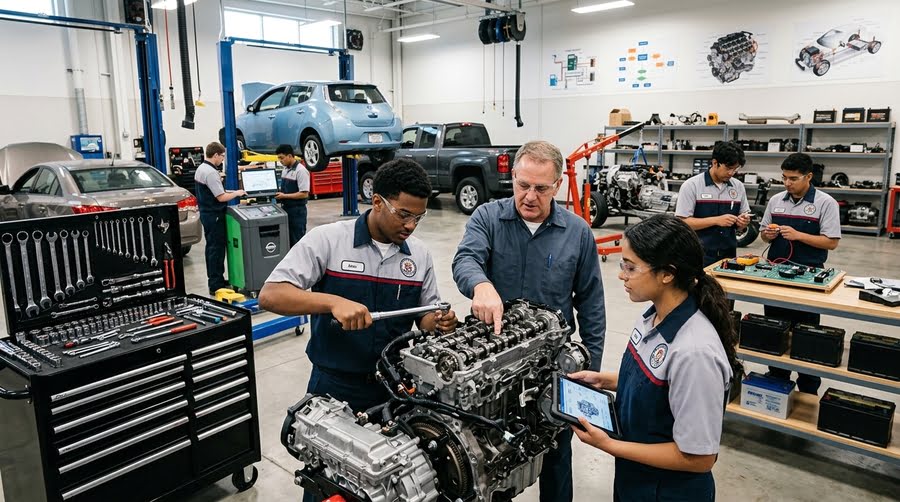
Reading about how an automatic transmission balances fluid pressure to shift gears is about as exciting as reading a washing machine manual. Your eyes glaze over, the acronyms blur together, and you forget half of it by the next morning. A truly great program understands this human limitation. It structures the day so that you spend an hour learning the underlying physics of a system, and then immediately spend the next three hours tearing that exact system apart on a lift.
This tight feedback loop between your brain and your hands is where real learning lives. When you are physically holding a worn-out clutch plate or looking at a scored cylinder wall that you just diagnosed yourself, the textbook diagrams will start making perfect sense.
2. Instructors Who Are Mentors
Have you ever had a teacher who clearly hadn’t worked in an actual repair shop since the nineties? It’s a massive red flag. In an industry where vehicle technology updates almost overnight, you need to learn from people who are still actively fighting the battles of the modern workshop. The best instructors act as workshop mentors, sharing the unwritten rules of the trade that you will never find in an official factory manual.
These veterans also bring real-world context into every single lesson. When they walk you through a diagnostic routine, they aren’t just teaching you how to pass a standardized test. They are teaching you how to save time, how to avoid misdiagnosing expensive computer modules, and how to talk to a frustrated customer without losing your cool.
3. Diagnostic Reasoning
Anyone can learn how to unbolt a broken alternator and slap a new one on. That is basic assembly work, and frankly, it’s not what makes a technician valuable anymore. The real money and the real respect in the modern automotive world belong to the master troubleshooters—the people who can look at a vehicle with a bizarre, intermittent electrical ghost and systematically hunt down the root cause.
A top-tier educational program shifts its entire focus away from rote memorization and toward diagnostic reasoning. From day one, you are taught how to think like a detective. You learn how to use advanced oscilloscopes, multi-meters, and scan tools to interrogate a vehicle’s network, mapping out data patterns instead of just blindly swapping out parts hoping for a fix. It’s a highly logical, scientific process that turns chaos into order.
Summing Up
At the end of the day, a truly effective automotive education program isn’t defined by the size of its lecture halls or the glossiness of its brochures. It’s defined by the confidence you feel when you stand alone in front of an open hood with a tool box by your side. By choosing a path that prioritizes immediate hands-on application, expert mentorship, and diagnostic depth, you turn a confusing learning process into a launchpad for an incredible career.