What Arizona Drivers Need to Know After a Car Accident
Arizona roads carry a serious volume of traffic, and the consequences of a bad collision extend well beyond the crash scene. Understanding the legal and insurance landscape before an accident happens, and knowing what to do immediately after, can make a real difference in how a claim unfolds.
The Scale of the Problem on the Roads
The numbers behind crash data are hard to ignore. There were 1,228 traffic fatalities across all roads in 2024, representing a 6.12% drop from 2023, according to the Arizona Department of Transportation’s Motor Vehicle Crash Facts report, while total crashes fell from 123,256 in 2023 to 121,107 in 2024. The modest improvement is welcome. But the crash volume remains high enough that every driver in the state carries a realistic exposure to collision risk.
Maricopa County bore the heaviest share of that burden, recording 88,094 crashes, 25,990 injuries, and 560 fatalities in 2024. Cities like Mesa, Tempe, and Chandler all appeared prominently in the statewide totals, reflecting how densely traveled the East Valley corridor has become.
The Leading Causes
The data show that crashes and fatalities are driven by driver behavior: impairment, speed, and failure to use seatbelts. At least 8,289 drivers involved in collisions in 2024 were engaged in some type of distracted driving behavior, and that figure likely understates the true count, since drivers involved in fatal crashes may not accurately self-report, and survivors often don’t either.
Rural Roads Carry Disproportionate Risk
Despite having fewer overall crashes, a greater percentage of fatal crashes occurred in rural areas, with 2.41% fatality rates versus 0.70% in urban areas. Higher speeds, longer emergency response times, and roads with fewer safety features create conditions where collisions are more likely to be fatal, even when they occur less often.
How Arizona’s Fault System Shapes the Claims Process
Arizona operates as an at-fault state, which means the driver who caused the accident bears financial responsibility for the resulting damages. That responsibility flows through their liability coverage, and the claims process begins with identifying which policy applies and what its limits are.
The state’s minimum coverage requirements are $25,000 per person and $50,000 per accident for bodily injury, along with $15,000 for property damage. Those limits can be exhausted quickly in a serious crash involving hospitalization, surgery, or extended rehabilitation. When that happens, injured parties may have the right to pursue additional recovery through their own underinsured motorist coverage, through the at-fault driver’s personal assets, or through other applicable policies.
An insurance adjuster working on behalf of the at-fault driver’s carrier has a direct financial incentive to minimize the payout. Recorded statements, early settlement offers, and requests for medical authorizations are all tools adjusters use to control the value of a claim. Knowing these tactics exist is the first step toward not being caught off guard.
The Uninsured Motorist Problem
One of the most complicating factors in Arizona accident claims is how often the at-fault driver carries no insurance at all. Approximately 12% of motorists are uninsured, compared to the 13% national rate. That translates to roughly one in eight drivers on the road operating without the liability coverage the law requires.
Uninsured motorist coverage steps in when the other driver has no insurance, whereas underinsured motorist coverage applies when the other driver’s policy isn’t enough to cover the costs. The law requires all motorists to carry liability insurance, but not all do, and out-of-state drivers may not have coverage either, making both types of protection worth carrying.
Drivers who decline this coverage in writing take on considerable financial exposure. A collision with an uninsured motorist can leave a badly injured person with no viable source of compensation beyond their own policy, regardless of how clear the fault picture is. No coverage, no recourse.
Steps to Take Immediately After a Crash
The actions taken in the hours and days following a collision directly affect the strength of any subsequent claim. A few priorities stand out.
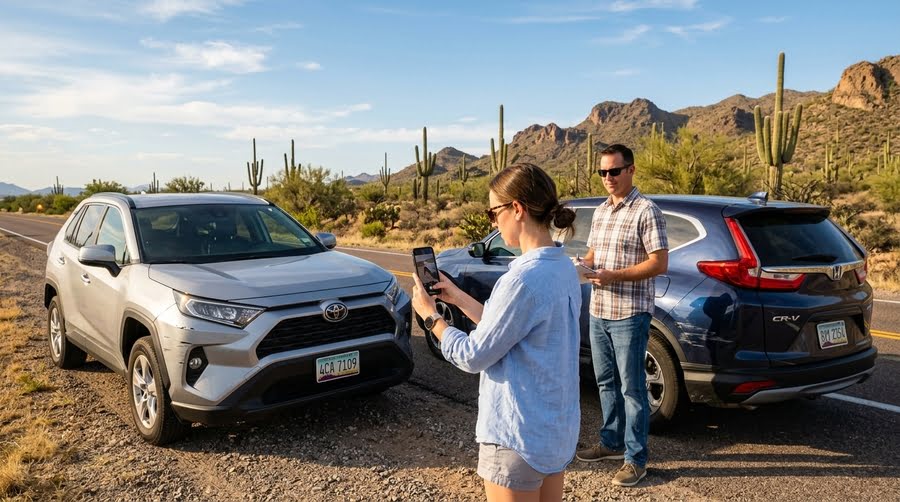
- Document the scene thoroughly. Photographs of vehicle positions, road conditions, skid marks, traffic controls, and visible injuries create a record that cannot be reconstructed later.
- Seek medical attention promptly. Gaps in treatment give insurance adjusters grounds to argue that injuries weren’t caused by the crash or weren’t as serious as claimed.
- Avoid giving recorded statements. A recorded statement to the opposing insurer is not required and can be used to limit the value of a claim.
- Preserve all documentation. Medical records, repair estimates, wage loss records, and correspondence with insurers all become relevant during the claims process.
- Understand the statute of limitations. Arizona generally allows two years from the date of a crash to file a personal injury lawsuit, and missing that deadline forfeits the right to recover.
When the Insurance Process Breaks Down
Most accident claims in Arizona resolve through the insurance process without litigation. But disputes over fault, disagreements about the extent of injuries, and bad-faith conduct by insurers are all situations where the process can stall or produce an inadequate result.
The question of whether to hire a car accident attorney often comes down to injury severity and how complicated the liability picture is. Soft-tissue claims with clear fault and cooperative insurers may resolve without legal representation. Cases involving disputed fault, multiple vehicles, serious injuries, or an uninsured driver are a different matter entirely.
The gap between what an insurer initially offers and what a claim is actually worth tends to be widest in exactly those situations.
What Adequate Coverage Actually Looks Like
Between 35% and 40% of Arizona motorists carry only the bare minimum coverage required by law. For many, that means $25,000 in bodily injury liability per person, an amount a single emergency room visit can approach or exceed.
Carrying limits above the state minimum, along with meaningful uninsured and underinsured motorist coverage, is the most direct way to protect against the financial consequences of a serious crash, whether fault lies with another driver or the coverage question turns back on your own policy.
The Takeaway
Arizona’s crash data reflects a road environment where serious collisions are a routine occurrence, not an exceptional one. The legal and insurance systems governing what happens after a crash are complex, and the decisions made in the immediate aftermath carry real weight.
Drivers who understand how liability coverage, policy limits, and the uninsured motorist landscape interact are far better positioned to protect their interests when something goes wrong.