Toyota 4Runner Years to Avoid: A Comprehensive Guide
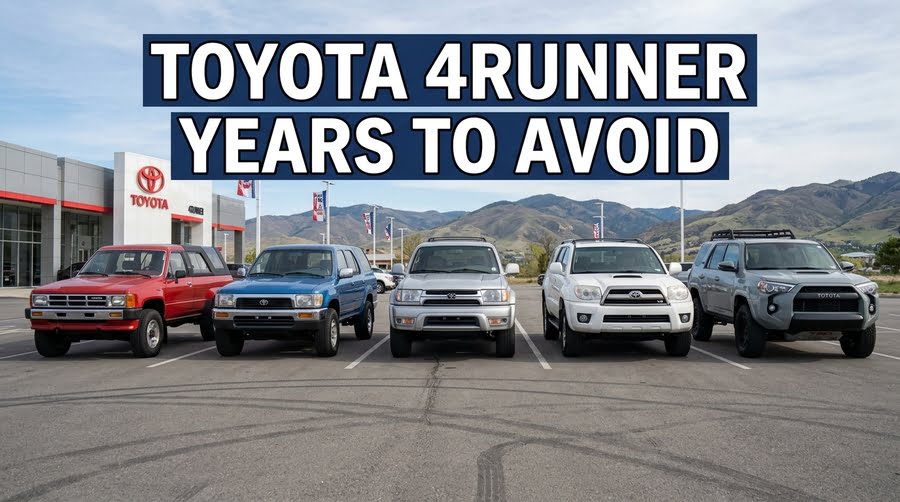
The Toyota 4Runner years to avoid are 2003–2005 (fourth generation), 2001–2002 (third generation), 1990–1995 with the 3.0-liter V6 (second generation), and 1988–1989 with the 3.0-liter V6 (first generation). The 2010–2013 fifth-generation models and the 2015 model year also carry enough documented issues to warrant extra inspection before purchase.
The Toyota 4Runner is one of the most durable SUVs ever built. Owners regularly push these vehicles past 300,000 miles (482,803 km) with proper maintenance. The 4Runner has earned a loyal following among off-road enthusiasts, families, and daily drivers who value body-on-frame construction and Toyota’s reputation for longevity.
But not every model year lives up to that reputation. The 3.0-liter V6 engine carried a design flaw that caused recurring head gasket failures across two generations. Frame rust has eaten through undercarriages on third and fourth-generation models, particularly in snow belt regions. Dashboard cracking, airbag system failures, brake problems, and transmission issues have affected specific model years more than others.
This guide covers the worst Toyota 4Runner years by generation, common problems by model year, the best years to buy instead, a pre-purchase inspection checklist, alternatives to the problematic years, and answers to buyer questions. Knowing which 4Runner years to skip saves thousands in repair costs and delivers the reliable ownership experience the nameplate is known for.
Worst Years for the Toyota 4Runner
The Toyota 4Runner has been in production since 1984 across six generations. Each generation has produced both reliable winners and problematic model years. The pattern is consistent: certain engine configurations and early-production years carry more risk than later-cycle models within the same generation.
First Generation (1988-1989 with 3.0L V6)
The first-generation Toyota 4Runner ran from 1984 to 1989. The 1984–1987 models equipped with the 2.4-liter I4 engine are reliable and sought-after by off-road enthusiasts. But the 1988–1989 models that received the 3.0-liter V6 engine introduced a design flaw that would plague the 4Runner for years.
The problem: The 3.0-liter V6 has a head gasket design deficiency that causes repeated failures. The gaskets blow, get repaired at significant cost, then blow again. The engine design itself prevents a permanent fix. Repair costs for head gasket replacement on these models typically exceed $1,500–$2,500 per occurrence, and the problem recurs.
The 2.4-liter I4 models from 1986–1987 are the better first-generation picks. They lack the V6 power but deliver the reliability that built the 4Runner’s reputation. Any first-generation 4Runner at this age (35+ years) will have the standard old-vehicle issues: leaks, rust, sagging suspension, and worn components.
Second Generation (1990-1995 with 3.0L V6)
The second-generation Toyota 4Runner (1990–1995) carried over the same problematic 3.0-liter V6 engine from the first generation. The head gasket flaw persisted across all V6-equipped models in this generation.
Head gasket failures are the primary concern. The gaskets fail, get repaired, and fail again because the engine design cannot prevent the issue. After many miles, these 4Runners also develop:
- Sagging suspension requiring spring or strut replacement
- Power steering leaks from aging hoses and pump seals
- Standard rust accumulation on body panels and undercarriage
The 1990–1993 models equipped with the 2.4-liter I4 engine are far more reliable, avoiding the head gasket problem entirely. The I4 models sacrifice power but gain dependability, making them better used-car purchases for buyers who prioritize low maintenance costs over V6 performance.
Toyota’s reliability reputation extends beyond the 4Runner, but every model line has weak years. Our guide covering which RAV4 model years have the most owner complaints shows how even Toyota’s best-selling compact SUV has specific years that need extra caution.
Third Generation (2001-2002)
The third-generation Toyota 4Runner (1996–2002) is widely popular among enthusiasts. The 1999–2000 models with full-time all-wheel drive and available manual transmission are particularly desirable. But the 2001–2002 models introduced changes that reduced capability and added new problems.
The 2001–2002 Toyota 4Runner issues:
- Worst rust problems of any 4Runner generation — frame and body corrosion reaching structural levels
- Toyota removed the manual transmission option (2001 onward)
- Toyota removed the locking rear differential, reducing off-road capability
- Head gasket issues carried over from earlier generations (though less severe than the 3.0L V6)
- Early signs of the frame rust problem that would define the fourth generation
The rust problem on 2001–2002 4Runners is severe enough that structurally compromised frames have been found on vehicles that appeared mechanically sound during test drives. A shop visit is necessary to assess frame condition before purchase. Snow belt undercarriage rot is the primary concern for these models.
The 1996–1998 third-generation models have fewer documented problems and avoid the worst of the rust issues affecting later years. The 1999–2000 models are the most capable off-road, with multimode transfer case and available rear locker.
Fourth Generation (2003-2005)
The 2003–2005 fourth-generation Toyota 4Runner represents the worst 4Runner years to avoid for most buyers. These three model years combine the most severe problems in 4Runner history: frame rust, head gasket failure, and dashboard cracking all in one package.
2003 Toyota 4Runner — The most owner complaints of any 4Runner model year ever. Over 400 NHTSA complaints for the 2003 model alone.
2004 Toyota 4Runner — Severe dashboard cracking problem. Dashboards exposed to direct sunlight melted, cracked, and deformed. This cosmetic issue can prevent airbag deployment, creating a safety hazard beyond appearance.
2005 Toyota 4Runner — Continues the head gasket and frame rust concerns of the 2003–2004 models.
Common problems across 2003–2005:
- Head gasket leaking or failing (expensive repair: $2,000–$4,000)
- Severe frame rust and underbody corrosion, particularly in salt-prone regions
- Air injection pump failures
- Faulty anti-lock braking system
- Glitchy check engine light
- Dashboard cracking and melting (2004 especially)
- Over 400 NHTSA complaints per model year for 2003–2007
The 2003–2005 frame corrosion problem is serious enough that many otherwise-running 4Runners have been taken off the road because their frames were structurally compromised. A 4Runner that “runs fine” can still have a rusted frame that makes the vehicle unsafe.
The 2006–2007 models improved significantly, and the 2008–2009 4Runners received only 54 complaints per model year (compared with 400+ for 2003–2005). The 2008–2009 models are also less prone to rust and are among the best fourth-generation picks.
Fifth Generation (2010-2013)
The fifth-generation Toyota 4Runner (2010–present) is the most refined and modern generation. The 2010–2013 models are not terrible vehicles, but they have documented issues that separate them from the near-flawless 2017+ models.
2010–2013 Toyota 4Runner issues:
- Failed airbag system deployment — reported to the National Highway Traffic Safety Administration (NHTSA) as the most common complaint for these years. A recall addressed this, and properly repaired vehicles should function correctly.
- Driveshaft and axle issues reported by Consumer Reports owners
- Excessive body roll affecting ride quality
- In-car electronics glitches and infotainment system problems
- Post-2010 torque converter shudder at highway speeds
- 2011–2013 water pump leaks on some examples
- Rougher on-road ride compared with competitors
These are not catastrophic failures. The airbag recall has been addressed. The electronics issues are annoyances rather than safety hazards. But for buyers who want a trouble-free fifth-generation 4Runner, the 2017+ models are the safer choice with zero common problems reported.
2015 Model Year
The 2015 Toyota 4Runner sits in a transitional period for the fifth generation. This model year has enough documented issues to warrant careful inspection:
- Brake system problems (temporary lockup, warping, premature wear)
- 2015 sunroof leak prone to water intrusion
- Door lock actuator failures
- 2014-2016 infotainment glitches
The 2015 model is not a hard avoid, but it needs a thorough pre-purchase inspection focused on brakes, electronics, and water intrusion. The 2016+ models reduced these complaints significantly.
Common Problems by Model Year
2000 Model Issues
The 2000 Toyota 4Runner sits at the end of the third generation with specific drawbacks:
- Toyota removed the locking rear differential (carried into 2001–2002)
- No manual transmission available
- Rust and paint quality problems — finding a 2000 4Runner without cosmetic damage is rare
- Poor paint job from the factory, leading to early fading and peeling
The 2000 model’s removal of the rear locker and manual transmission reduced off-road capability compared with the 1999 model. For off-road buyers, the 1999 4Runner is the superior pick in this generation due to taller factory coils, rear e-locker availability, and manual transmission option.
2003-2005 Issues
The 2003–2005 fourth-generation issues deserve detailed breakdown because they represent the most problematic era in 4Runner history:
| Problem | Severity | Typical Cost | Mileage at Failure |
|---|---|---|---|
| Head gasket failure | High | $2,000–$4,000 | 100,000–150,000 miles (160,934–241,402 km) |
| Frame rust/corrosion | High (safety) | $3,000–$5,000 for frame repair | 150,000+ miles in salt regions |
| Dashboard cracking (2004) | Moderate (airbag risk) | $1,500–$2,500 | Sun exposure dependent |
| Air injection pump failure | Moderate | $800–$1,500 | Varies |
| ABS malfunction | Moderate | $500–$1,200 | Varies |
The 2003 Toyota 4Runner has the most owner complaints of any 4Runner ever produced. By comparison, the 2008–2009 models within the same generation received roughly 90% fewer complaints per year.
Rust Problems
Rust is the single biggest threat to Toyota 4Runner longevity across all generations. The problem affects different generations at different severity levels:
- Third generation (1996–2002): Worst overall rust susceptibility. Frame and body panels corrode, especially in Midwest and Northeast states where road salt is used.
- Fourth generation (2003–2009): 2003–2005 frame corrosion is severe and structural. Toyota issued a recall/buyback program for some affected frames.
- Fifth generation (2010+): Less prone to rust than earlier generations, but not immune. Vehicles driven in snow belt regions still need annual undercarriage inspection.
Rust does not affect how a vehicle runs mechanically — until it compromises the frame. A rusted frame is a safety failure that cannot be ignored. Inspect the frame, suspension mounting points, and body-to-frame connections on any used 4Runner before purchase.
A structurally compromised frame that fails while driving creates serious collision risk. Understanding how accident-related costs accumulate across medical, legal, and vehicle categories reinforces why frame integrity is non-negotiable when evaluating any used SUV.
Brake Issues
Brake problems affected the 2014–2017 Toyota 4Runner models. Owners reported:
- Brakes locking up temporarily during normal driving
- 2014 brake caliper seizure on some vehicles
- Warping and premature wear on front brake rotors
- Brake master cylinder failures requiring replacement
- Reduced stopping confidence under normal conditions
The brake master cylinder and front brake rotor were identified as the weak components. Check whether these parts have been replaced on any 2014–2017 4Runner before purchase. Brake system problems are safety-critical — vehicles with documented braking defects create danger at the intersections and highway stretches where most collisions in the United States occur.
Transmission Problems
Toyota 4Runner model years from 1990 to 2016 have documented transmission system problems. Symptoms include:
- Rough shifting between gears
- Loss of power during acceleration
- Delayed gear engagement
- Manual transmission synchro wear (older models)
- Post-2010 torque converter shudder at highway speeds
The primary culprits are faulty shift solenoids and throttle position sensors, both of which require replacement to resolve. These are moderate-cost repairs ($300–$800) rather than catastrophic failures, but they affect driving comfort and confidence.
The pre-2017 transmission failures concentrate in the 1990–1995 (V6 models with automatic), 2001–2002, and 2003–2005 model years. Fifth-generation models from 2017 onward have the fewest transmission complaints of any 4Runner generation.
Best Years for the Toyota 4Runner
The best Toyota 4Runner years to buy used span every generation. These models deliver the reliability, durability, and off-road capability that built the 4Runner’s reputation:
| Generation | Best Years | Why |
|---|---|---|
| First Gen | 1984–1987 (2.4L I4) | Reliable engine, no head gasket flaw, simple mechanics |
| Second Gen | 1994–1995 (2.4L I4) | Avoids 3.0L V6 problems, proven platform |
| Third Gen | 1999–2000 | Full-time AWD, manual transmission available, rear locker, tallest factory coils |
| Fourth Gen | 2008–2009 | Only 54 complaints/year (vs. 400+ for 2003–2005), less rust, refined ride |
| Fifth Gen | 2017–2021 | Zero common problems reported, updated safety tech, best reliability scores |
Highest Rated Years
The highest-rated Toyota 4Runner model years by owner and expert scores:
- 2017 Toyota 4Runner: Edmunds 4.6/5, J.D. Power 87/100 (highest ever for a 4Runner), zero common problems reported to NHTSA
- 2001 Toyota 4Runner: Edmunds 4.8/5 (despite off-road capability reduction, owners praise daily reliability)
- 2009 Toyota 4Runner: Edmunds 4.5/5, Kelley Blue Book 4.8/5, J.D. Power 84/100
- 2012 Toyota 4Runner: Edmunds 4.5/5, Kelley Blue Book 4.6/5, J.D. Power 84/100
The 2017 model year is widely considered the best pre-owned 4Runner available. It combines the mature fifth-generation platform with updated safety features, modern infotainment, and the lowest complaint count in 4Runner history. The 2017–2021 range as a whole receives near-universal praise from owners and reviewers.
Toyota’s reliability patterns vary between model lines. The best Toyota Camry years follow a similar pattern where mid-cycle and late-cycle models outperform first-year redesigns. Understanding which Camry years have documented reliability concerns helps Toyota buyers see that even the brand’s most popular sedan has weaker production years.
Tips for Buying a Used Toyota 4Runner
What to Look For
The Toyota 4Runner buying process differs from most SUVs because rust and mechanical history matter more than cosmetics or mileage alone. A 4Runner with 200,000 miles and complete service records from Arizona is often a better purchase than a 60,000-mile example from Michigan with no maintenance history.
5 things to prioritize when shopping:
- Frame condition (rust is the #1 threat to 4Runner longevity)
- Head gasket history (has it been replaced on V6 models from 1988–2005?)
- Service records showing regular oil changes, transmission fluid services, and timing belt replacement (V8 models)
- Region of origin (dry climate vehicles last longer than snow belt vehicles)
- Brake system condition (2014–2017 models need specific attention)
Pre-Purchase Inspection Checklist
| Checkpoint | What to Look For | Generation Focus |
|---|---|---|
| Frame inspection | Rust, corrosion, structural weakness at mounting points | All, especially 3rd and 4th gen |
| Undercarriage | Snow belt undercarriage rot, fluid leaks, suspension mounting | All |
| Head gasket | Oil in coolant, coolant in oil, white exhaust smoke, overheating | 1st/2nd gen (3.0L V6), 4th gen |
| Dashboard | Cracking, melting, deformation (affects airbag deployment) | 4th gen, especially 2004 |
| Transmission | Shift quality, delayed engagement, rough shifts, shudder | 1990–2016 models |
| Brakes | Rotor condition, pedal feel, lockup history, master cylinder | 2014–2017 |
| Airbag recall | Verify completion through NHTSA VIN lookup | 2010–2013 |
| Door locks | Test all actuators for proper function | 2014–2016 |
| Suspension | Sagging, worn shocks, clunking over bumps | All older models |
| Power steering | Leaks from pump, hoses, or rack; heavy steering feel | 2nd gen, 3rd gen |
Quick Shopping Tips
- Get a pre-purchase inspection focused on frame rust, suspension, and steering. Budget $100–$200 for the inspection — this saves thousands in hidden repair costs.
- Review service history for head gasket or engine work already completed. A 4Runner with a documented head gasket replacement has already absorbed that cost.
- Compare trim levels (SR5, TRD Off-Road, Limited) to match your needs. The SR5 offers the best value. The TRD Off-Road includes the locking differential. The Limited prioritizes comfort.
- Consider region of origin. A higher-mileage 4Runner from the Southwest is often a better bet than a low-mileage one from the Midwest.
- Run the VIN through NHTSA’s recall lookup before seeing the vehicle. Unresolved recalls (especially airbag recalls on 2010–2013 models) create safety risk.
- Check whether the 2005 4Runner base SR5 has a manual transmission, if that matters to you — 2005 was the last year Toyota offered a stick shift in the 4Runner.
If you plan to let others drive your 4Runner, understand the liability exposure. Knowing who bears financial responsibility when someone else wrecks your vehicle helps you make smarter insurance decisions, especially on a high-value used SUV. The situation gets worse when the person behind the wheel lacks a valid license.
Alternatives to Avoided Years
Buyers who want a reliable used SUV but are concerned about the 4Runner’s problem years have several options:
| Alternative | Strength vs. 4Runner | Weakness vs. 4Runner |
|---|---|---|
| Toyota Land Cruiser | More refined, equally durable | Higher price, worse fuel economy |
| Lexus GX 470/460 | Same Toyota drivetrain, luxury interior | Higher purchase price |
| Toyota Tacoma (crew cab) | Body-on-frame, similar reliability | Less passenger/cargo space |
| Honda Pilot | Smoother ride, better fuel economy | Less off-road capability |
| Jeep Grand Cherokee | Off-road capability, luxury options | Lower long-term reliability |
The best alternative to a problem-year 4Runner is simply a good-year 4Runner. Moving from a 2003 to a 2008 model within the same generation eliminates most risk while keeping the same body style, size, and capability. Paying slightly more for a 2008–2009 fourth-generation 4Runner or a 2017+ fifth-generation 4Runner delivers dramatically better ownership experience than saving money on a 2003–2005 model.
For buyers cross-shopping other SUVs, our guides help compare alternatives on the same terms. The Honda Pilot is a common 4Runner alternative — understanding which Pilot production years carry the most risk helps you choose confidently. The same applies to Jeep Grand Cherokee model years with documented reliability problems and which Honda CR-V years have owner-reported issues.
If you are comparing Toyota models specifically, the Corolla’s best years offer a completely different ownership profile — lower purchase price, better fuel economy, and simpler maintenance, though without the 4Runner’s off-road capability or towing capacity.
Frequently Asked Questions
Is the Toyota 4Runner a reliable truck?
Yes, the Toyota 4Runner is one of the most reliable SUVs ever produced. Most 4Runner concerns outside of rust and paint are repairable, and the vehicle is widely viewed as durable enough to exceed 300,000 miles (482,803 km) with proper maintenance. The key is choosing the right model year. The 2008–2009 and 2017+ models have the strongest reliability records. The 2003–2005 models have the weakest. Save for the 3.0-liter V6 head gasket flaw and frame rust on older models, most 4Runner issues are moderate-cost repairs that do not compromise the vehicle’s fundamental longevity.
Are issues easy to fix on a Toyota 4Runner?
Yes, most Toyota 4Runner issues are straightforward to repair for experienced mechanics. Shift solenoids, throttle position sensors, brake rotors, and door lock actuators are all accessible components with readily available replacement parts. Older models (1984–2002) are particularly garage-friendly due to simpler mechanical systems without complex electronics. Newer models (2010+) have computer systems and sensors that may require diagnostic tools and dealer-level equipment, making at-home repairs more challenging for those specific systems.
What should I do before buying a used Toyota 4Runner?
Get a pre-purchase inspection from a trusted mechanic focused on frame rust, suspension condition, and head gasket history. Request a vehicle history report from CarFax or another service. Run the VIN through NHTSA’s recall lookup to verify all recalls are completed (especially airbag recalls on 2010–2013 models). Check the region the vehicle spent its life in — dry-climate 4Runners hold up better against rust than snow-belt vehicles. Verify maintenance records showing regular oil changes, transmission services, and timing belt replacement (V8 fourth-generation models).
How much does a used Toyota 4Runner typically cost?
Used Toyota 4Runner prices range from approximately $8,000–$15,000 for 2008–2009 fourth-generation models to $35,000–$45,000 for 2020+ fifth-generation models. CoPilot Price Pulse data shows a typical 2008 4Runner at $14,064 (reflecting a 39% market premium over normal conditions) and a 2020 4Runner at $42,028 (including an 8% market premium). The 4Runner’s strong resale value reflects high demand — these SUVs hold value better than most competitors, which means paying more upfront but losing less to depreciation over time.
For budget buyers comparing ownership costs, affordable lease options under $200 monthly exist for other vehicles but rarely include a vehicle as capable as the 4Runner. The 4Runner’s high resale value makes buying used and selling later a strong financial strategy compared with leasing.
Is the Toyota 4Runner a good car to purchase?
Yes, the Toyota 4Runner is an excellent SUV purchase when you choose from the reliable model years (1999–2000, 2008–2009, 2017–2021). The 4Runner offers body-on-frame durability, genuine off-road capability with available locking rear differential, comfortable highway ride, and proven longevity exceeding 300,000 miles. Picking the wrong 4Runner year (2003–2005 especially) leads to expensive head gasket repairs, frame rust concerns, and frustrated ownership. Picking the right year delivers the legendary dependability the nameplate is known for.
Be aware that lease agreements carry financial penalties for excess wear and early termination, which matters for a vehicle frequently used off-road where body damage is more likely. Purchasing outright is typically the better path for 4Runner buyers who plan trail use.
Conclusion
The Toyota 4Runner years to avoid — 2003–2005 (fourth generation), 2001–2002 (third generation), 1990–1995 with the 3.0L V6 (second generation), and 1988–1989 with the 3.0L V6 (first generation) — share common threads. The 3.0-liter V6 head gasket flaw affects first and second-generation models. Frame rust affects third and fourth-generation vehicles. The 2003–2005 models combine both problems plus dashboard cracking into the worst 4Runner ownership experience available.
The 2010–2013 fifth-generation models have documented airbag and electronics issues that are less severe but still worth knowing about. The 2015 model has brake and water intrusion concerns.
The best Toyota 4Runner years for used buyers are 2008–2009 (fourth generation, dramatic improvement over 2003–2005) and 2017–2021 (fifth generation, zero common problems, highest ratings). The 1999–2000 models are the best third-generation picks for off-road capability. The 2.4-liter I4 models from 1984–1995 are the most reliable options for buyers who want a first or second-generation 4Runner without the V6 head gasket risk.
A properly chosen 4Runner delivers one of the most dependable, long-lasting SUV ownership experiences available. The vehicle’s body-on-frame construction, proven powertrains (outside the 3.0L V6), and off-road capability make the right-year 4Runner worth every dollar. The wrong-year 4Runner delivers expensive head gasket repairs, structural rust, and regret.
Always inspect the frame, verify recall completion, check service records, and consider climate history before buying any used 4Runner. These steps — combined with choosing from the reliable model years — ensure you get the 4Runner experience that made the nameplate legendary.
Unexpected incidents happen regardless of vehicle reliability. The Trey Gowdy car accident and Brittany Johns car incident both show that collisions affect drivers in every vehicle class. Understanding what financial obligations arise if you wreck a leased vehicle or the insurance process after damaging a rental helps you plan coverage appropriate to your 4Runner’s value and how you use it. And knowing whether your employer can take action after a company vehicle collision is relevant for 4Runner owners who use their SUV for work purposes.