Leasing a Car Is a Method of Financing Where Someone ______.
Question: Leasing a car is a method of financing where someone __________________.
a. Never pays any interest or fees b. Is paying off two or more vehicles at one time c. Makes monthly payments on but does not own the vehicle d. Does not have to pay any taxes on the vehicle for the first six months
Answer: c. Makes monthly payments on but does not own the vehicle
Leasing a car is a method of financing where someone makes monthly payments on but does not own the vehicle. The lessee pays for depreciation and usage during a set period (typically 24 to 48 months), then returns the vehicle to the leasing company when the lease term ends. Option (a) is incorrect because lease payments include interest charges (called the money factor) and various fees. Option (b) is incorrect because leasing involves one vehicle per agreement, not multiple vehicles. Option (d) is incorrect because lessees pay sales tax on lease payments in most states from the first month.
Car leasing offers 3 main benefits: lower monthly payments compared to financing, access to newer vehicles with updated features, and reduced maintenance costs since lease terms align with manufacturer warranty periods. People use car leasing for personal transportation, business vehicle needs, and short-term driving solutions. A standard lease agreement contains 5 core components: the capitalized cost (vehicle price), residual value (end-of-lease worth), money factor (interest rate equivalent), lease term length, and mileage allowance. This guide covers car leasing basics, financing alternatives, cost comparisons, and decision-making factors to help you choose between leasing, financing, and buying with cash.
Understanding the Basics
To choose the right car acquisition method, you need to understand how leasing, financing, and cash purchases work and what each option requires from you financially.
What Is Car Leasing?
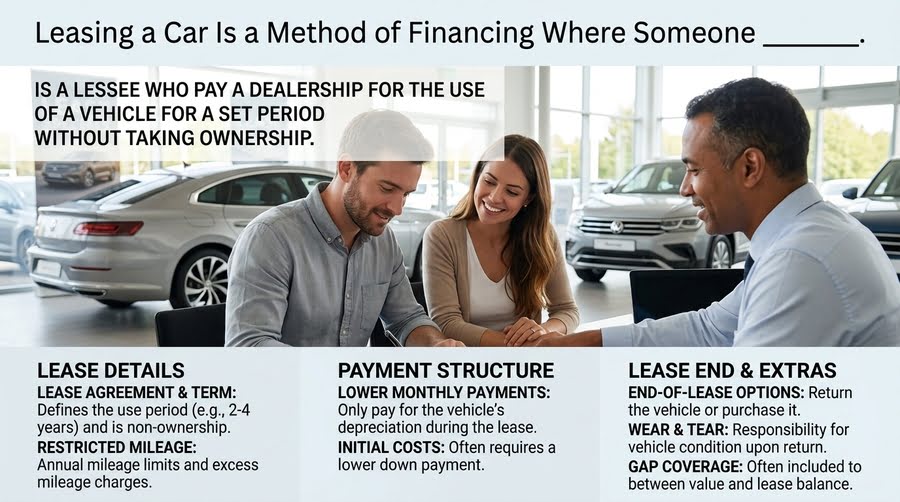
Car leasing is a contract agreement where you pay monthly fees to drive a vehicle for a specified period without gaining ownership. The lease term runs between 24 to 48 months in most cases. Your monthly lease payment covers the vehicle’s depreciation during your usage period, plus interest charges (called the money factor), taxes, and fees.
At lease end, you have 3 options: return the vehicle to the dealership, purchase the car at a predetermined residual value, or start a new lease on a different model. The residual value represents the estimated worth of the vehicle at lease termination, and lease agreements establish this figure when you sign the contract.
Leasing companies like Toyota Financial Services, Ford Credit, LeasePlan, and manufacturer-affiliated lenders handle most consumer car leases. These closed-end lease contracts protect you from residual value risk because your end-of-lease obligations stay fixed regardless of actual market value changes.
What Is Car Financing?
Car financing involves borrowing money through an auto loan to purchase a vehicle, then repaying the loan with interest over a set period. The loan term typically ranges from 36 to 72 months, with some lenders offering 84-month terms.
When you finance a car, you make monthly payments toward full ownership. Each payment reduces your principal balance and covers interest charges. The vehicle title transfers to you once you complete all payments, giving you full equity in the car.
Your credit score determines the annual percentage rate (APR) you receive on auto loans. Higher credit scores qualify for lower interest rates, reducing total loan costs. Financing lets you build equity as you pay down the loan balance—something leasing does not provide.
What Is Buying a Car With Cash?
Buying a car with cash means paying the full purchase price upfront without loans or monthly payments. This method provides immediate ownership and eliminates interest charges entirely.
Cash buyers receive the vehicle title at purchase completion. There are no monthly obligations, no debt, and no risk of repossession. Cash purchases work best for buyers with sufficient savings who want to avoid financing costs and prefer straightforward car lease agreements without penalties or restrictions.
The downside is tying up large amounts of capital in a depreciating asset. Cash purchases also do not build credit history since no loan payments occur.
Ways to Finance a Car
There are 3 primary sources for auto financing, each offering different rates, terms, and approval requirements based on your financial situation.
Dealership Financing
Dealership financing provides auto loans directly through the car dealer’s finance department. Dealers work with multiple lending partners to find loan options for customers with varying credit profiles.
Dealer financing offers convenience since you complete the purchase and financing in one location. Manufacturers sometimes offer promotional rates (0% APR or reduced rates) through their captive finance arms on specific models. These manufacturer-subvented loans can save thousands in interest costs.
Dealership finance managers may mark up interest rates above what lenders charge, increasing their profit. Always compare dealer offers against outside financing to ensure competitive terms.
Your Bank or Credit Union
Banks and credit unions provide auto loans with rates based on your existing relationship and creditworthiness. Credit unions often offer lower rates than banks because they operate as nonprofit member organizations.
Getting pre-approved through your bank or credit union before shopping gives you negotiating power at dealerships. Pre-approval establishes your maximum loan amount and interest rate, so you know your budget before selecting a vehicle.
Bank and credit union loans work for both new and used car purchases. These lenders typically have stricter approval requirements than dealership financing, requiring higher credit scores and stable income verification.
Get a Personal Loan
Personal loans from online lenders or banks can finance car purchases when traditional auto loans are unavailable. Personal loans are unsecured, meaning no collateral backs the loan.
Interest rates on personal loans typically run higher than secured auto loans because lenders face more risk. Personal loans make sense when you have credit challenges, need flexible loan amounts, or want to purchase from private sellers who cannot process traditional financing.
Online lenders like those featured in financial resources often approve applications quickly, sometimes within 24 hours. Personal loan terms range from 12 to 84 months depending on the lender and your qualifications.
Ways to Lease Your Car
Car leasing options include dealership programs, manufacturer direct leasing, and third-party arrangements, each structured differently for varying customer needs.
Dealership Leasing
Dealership leasing handles most consumer car leases through the dealer’s finance office. You negotiate the vehicle price, select lease terms, and complete paperwork at the dealership.
Dealers can adjust lease terms including the capitalized cost, money factor, mileage allowance, and lease duration. You should negotiate the selling price of the vehicle before discussing lease terms since the capitalized cost directly affects your monthly payment.
Dealership lease specials often feature reduced money factors or waived acquisition fees on specific models. These promotional offers change monthly, so timing your lease can generate savings. If you’re exploring car leases under $200 a month with no money down, dealership specials provide the best opportunities.
Manufacturer Leasing
Manufacturer leasing programs come directly from automaker finance divisions like Toyota Financial Services, Ford Credit, or Honda Financial Services. These captive lenders create lease programs specifically for their vehicle brands.
Manufacturer lease programs often include loyalty bonuses for returning customers, conquest offers for buyers switching brands, and special rates for recent college graduates or military personnel. These incentives reduce effective lease costs below standard market rates.
Manufacturer leasing provides standardized terms and consistent customer service through dedicated support channels. End-of-lease processes follow established procedures, making vehicle returns predictable.
Third-Party Lending
Third-party leasing involves non-manufacturer lenders who provide lease financing independently from dealerships. Companies like LeasePlan, Enterprise Fleet Management, and various banks offer these programs.
Third-party leases can provide options for customers who do not qualify for manufacturer programs or who want different terms than dealers offer. These arrangements sometimes work for used car leases, which manufacturer programs rarely support.
Lease assumption marketplaces allow lessees to transfer existing leases to new parties through third-party services. This option helps people exit leases early without paying full termination penalties.
Car Leasing vs. Financing vs. Buying: Pros and Cons
Understanding 6 key comparison factors helps determine which acquisition method fits your situation best.
Monthly Payments
Lease payments run 30% to 40% lower than finance payments on the same vehicle because you pay only for depreciation, not full purchase price. A vehicle worth $40,000 (USD) / approximately €37,000 (EUR) might have a $450 monthly lease payment versus $650 monthly financing payment over similar terms.
Lower lease payments let you drive more expensive vehicles within the same monthly budget. Finance payments build equity but require larger monthly outlays. Cash purchases eliminate monthly payments entirely but require full upfront capital.
If you’re considering a Honda CR-V, Toyota RAV4, or Mazda CX-5, comparing lease versus finance payments on your preferred model year shows real cost differences.
Down Payment
Lease down payments (called capitalized cost reductions) typically range from $0 to $3,000, while finance down payments often require 10% to 20% of the vehicle price. Cash purchases require 100% of the price upfront.
Putting money down on a lease reduces monthly payments but does not build equity since you do not own the vehicle. Finance down payments reduce loan amounts and lower total interest paid over the loan term.
Many lease specials advertise “sign and drive” offers requiring only the first month’s payment and fees at signing, minimizing initial cash outlay.
Maintenance and Repair Costs
Leased vehicles stay under manufacturer warranty coverage throughout most lease terms, reducing or eliminating repair expenses. Standard lease terms (24-36 months) align with 3-year/36,000-mile (57,936 km) basic warranties.
Financed and cash-purchased vehicles eventually exceed warranty coverage, making owners responsible for all repairs. Older vehicles like the Ford Explorer or Jeep Grand Cherokee may require significant maintenance as mileage accumulates.
Lessees must maintain vehicles according to manufacturer specifications and return them in good condition, excluding normal wear and tear. Excess wear charges apply for damage beyond normal use.
Early Termination
Ending a lease early triggers substantial penalties, often requiring payment of remaining lease obligations minus the vehicle’s current value. Early lease termination can cost thousands of dollars.
Financed vehicles can be sold at any time, though you must pay off the remaining loan balance. Owners with positive equity (vehicle worth more than loan balance) can sell without penalty. Negative equity requires paying the difference.
Understanding what happens if you crash a leased car or face unexpected circumstances helps you prepare for potential early termination scenarios. Gap insurance, often included in leases, covers the difference between insurance payouts and lease obligations in total loss situations.
Mileage Restrictions
Standard lease agreements include mileage limits of 10,000 to 15,000 miles (16,093 to 24,140 km) per year. Exceeding these limits incurs penalties of $0.15 to $0.30 per excess mile at lease end.
Financed and cash-purchased vehicles have no mileage restrictions. High-mileage drivers who log over 15,000 miles annually often find financing more cost-effective than leasing with excess mileage charges.
Lease mileage limits can be negotiated upward at lease signing for higher monthly payments. This approach costs less than paying excess mileage fees at lease end for drivers who know they will exceed standard limits.
Ownership
Leasing provides vehicle use without ownership—you return the car at lease end unless you exercise the purchase option. Financing builds ownership over time, with full ownership achieved when the loan is paid off. Cash purchases provide immediate ownership.
Ownership matters for people who want to modify vehicles, accumulate high mileage, or keep cars long-term. Leasing works for people who prefer driving newer vehicles every few years without ownership concerns.
Business users sometimes prefer leasing for fleet cycles, where vehicles rotate on regular schedules. Personal buyers who want to understand crash situations involving different ownership arrangements should consider how ownership affects liability and insurance.
Detailed Cost Analysis: Finance vs. Buy Car (Cash) vs. Lease
Understanding total costs over 5 years reveals true financial differences between acquisition methods.
Financing costs include: down payment (10-20% of vehicle price), monthly payments (principal plus interest), loan origination fees ($0-$500), registration and documentation fees ($200-$800), maintenance and repairs after warranty expires ($500-$2,000 annually), and sales tax on full purchase price.
Leasing costs include: security deposit or first payment ($0-$1,000), monthly payments ($300-$600 typically), acquisition fee ($395-$995), disposition fee at return ($300-$500), excess mileage charges (if applicable), wear and tear charges (if applicable), and sales tax on monthly payments (in most states).
Cash purchase costs include: full vehicle price upfront, registration and documentation fees ($200-$800), maintenance and repairs ($500-$2,000+ annually after warranty), and sales tax on full purchase price.
A $35,000 vehicle over 5 years might cost approximately:
- Lease (two 30-month terms): $18,000-$22,000 total payments, no equity remaining
- Finance (60-month loan at 6% APR): $40,500 total cost including interest, full equity in vehicle worth approximately $14,000-$18,000
- Cash purchase: $35,000 plus $3,000-$6,000 maintenance, full equity in vehicle worth approximately $14,000-$18,000
Car crashes in the United States result in high costs across medical, property, and productivity categories. Insurance costs remain similar across ownership types, though leasing companies require comprehensive and collision coverage throughout the lease term.
Lifestyle Considerations
Your driving habits, career situation, and personal preferences determine which acquisition method serves you best.
High-mileage drivers (over 15,000 miles annually) should avoid standard leases. Excess mileage charges add up quickly, often making financing more economical. If you commute long distances or travel frequently for work, financing or cash purchase eliminates mileage concerns.
People who want the latest features benefit from leasing. New safety technologies, infotainment systems, and efficiency improvements appear in recent model years. Leasing every 3 years keeps you in current vehicles without the hassle of selling or trading.
Budget-conscious drivers may prefer leasing for lower monthly payments or cash purchases to avoid interest entirely. Financing offers middle ground with reasonable payments while building ownership equity.
People who modify vehicles should finance or buy with cash. Leases prohibit modifications, and any changes must be reversed before return. Enthusiasts who customize wheels, suspension, or audio systems need ownership.
Knowing where most car crashes occur in the USA helps inform decisions about vehicle safety features, which update regularly on newer leased vehicles versus older financed or owned cars.
Special Situations & Tax Implications
Business use, self-employment, and specific tax situations affect which acquisition method provides the best financial advantage.
Business vehicle deductions differ by acquisition type. Lessees can deduct monthly lease payments as business expenses. Buyers can depreciate the vehicle’s value over time (typically 5 years) and deduct loan interest. The IRS sets annual limits on vehicle depreciation deductions, currently $12,200 for the first year on vehicles under 6,000 pounds (2,722 kg) gross vehicle weight.
Self-employed individuals often benefit from leasing because deduction calculations are straightforward—you deduct the business-use percentage of lease payments. Depreciation calculations for owned vehicles require more complex record-keeping.
State sales tax treatment varies by location. Some states charge sales tax on the full vehicle price even for leases. Others charge sales tax only on monthly payments, reducing total tax liability for lessees.
If you’re concerned about what happens with rental car accidents or similar liability questions, lease agreements specify insurance requirements and damage responsibilities clearly in the contract.
Consult a tax professional for advice specific to your situation, as tax laws change and individual circumstances vary significantly.
Who Should Consider Each Option?
Matching your situation to the right acquisition method prevents regret and financial strain.
Consider leasing when you:
- Want lower monthly payments
- Prefer driving newer vehicles with current technology
- Drive fewer than 15,000 miles annually
- Do not want to deal with selling or trading vehicles
- Run a business that benefits from lease payment deductions
- Have good credit (scores above 680 typically required for best lease terms)
Consider financing when you:
- Want to own your vehicle eventually
- Plan to keep the car for 5+ years
- Drive high mileage that would incur lease penalties
- Want to build credit through consistent loan payments
- May need to sell the vehicle before payoff
- Want flexibility to modify the vehicle
Consider buying with cash when you:
- Have sufficient savings without depleting emergency funds
- Want to avoid interest charges entirely
- Prefer immediate full ownership
- Do not need to build credit through auto payments
- Plan to keep the vehicle long-term
- Want maximum negotiating leverage at dealerships
Understanding whether you can get fired for crashing a company car matters for business vehicle decisions, as employer policies affect which acquisition method works for work-related transportation.
Before You Buy or Lease a Car
Preparation steps before visiting dealerships protect your interests and strengthen your negotiating position.
Check your credit score at least 30 days before shopping. Scores above 720 qualify for the best rates. Scores between 680-719 receive good rates. Scores below 680 face higher rates or may require subprime financing. Dispute any errors on your credit report before applying for financing or leases.
Calculate your monthly budget honestly. Include insurance costs (which increase for newer, more valuable leased vehicles), fuel, maintenance, and registration fees. Financial experts recommend keeping total transportation costs below 15-20% of monthly take-home income.
Research vehicle values using resources like Kelley Blue Book, Edmunds, and NADA Guides. For leases, know the vehicle’s invoice price (what the dealer paid) and current manufacturer incentives. For purchases, understand fair market values for negotiation.
Get pre-approved financing from your bank or credit union before dealership visits. Pre-approval establishes your rate and gives you comparison leverage against dealer financing offers.
Read reviews and reliability data for your target vehicles. Models like the Honda Accord, Toyota Camry, or Hyundai Santa Fe have specific model years with better or worse reliability records.
Factoring in a Trade-in
Your current vehicle’s value affects both lease and purchase transactions differently.
For leases, trade-in value reduces your capitalized cost, lowering monthly payments. A $5,000 trade-in on a 36-month lease reduces payments by approximately $139 per month (before fees and taxes).
For financing, trade-in value reduces the amount you need to borrow. This decreases both monthly payments and total interest paid over the loan term.
For cash purchases, trade-in value reduces the cash you need to provide, though you might get better value selling privately rather than trading at the dealership.
Get trade-in value estimates from multiple sources before negotiating. Dealerships may offer less than your vehicle’s worth, especially on older models or certain year vehicles with known issues that affect resale values.
Negotiate the trade-in value separately from the new vehicle price. Combining negotiations lets dealers shift numbers between transactions to obscure the actual deal you receive.
Signing the Paperwork
Contract review prevents surprises and ensures you receive the terms you negotiated.
For lease agreements, verify:
- Capitalized cost matches negotiated price
- Residual value appears correct for your mileage tier
- Money factor matches quoted rate (multiply by 2,400 to approximate APR)
- Mileage allowance reflects your needs
- Acquisition and disposition fees are disclosed
- Gap insurance inclusion (standard on most leases)
- Excess wear definitions and charges
For financing contracts, verify:
- Loan amount matches purchase price minus down payment and trade
- APR matches your pre-approved rate or dealer quote
- Loan term (months) reflects your agreement
- Monthly payment matches calculations
- Prepayment penalty clauses (avoid contracts with these)
- Required insurance coverage levels
For cash purchases, verify:
- Purchase price matches negotiation
- All fees are itemized and explained
- Trade-in credit appears correctly
- Title transfer process and timeline
Take contracts home to review if the dealer pressures you. Legitimate dealerships allow time for document review. Walking away from pressure tactics protects your interests.
After You Get the Car
Post-acquisition responsibilities differ based on your ownership type.
Lessees should:
- Maintain the vehicle according to manufacturer schedules
- Keep all service records for lease-end inspection
- Monitor mileage against annual allowance
- Report accidents and complete repairs properly
- Review what happens if an unlicensed driver crashes your car and ensure only authorized drivers operate the vehicle
- Schedule lease-end inspection 60-90 days before return
Financed vehicle owners should:
- Maintain insurance meeting lender requirements
- Make payments on time to protect credit scores
- Consider refinancing if rates drop or credit improves
- Track equity position for potential early payoff or sale
- Keep the vehicle in good condition for resale value
Cash buyers should:
- Maintain adequate insurance coverage
- Store the title securely
- Track maintenance to preserve resale value
- Consider extended warranty options for expensive repairs
Regardless of ownership type, understanding basic car accident procedures and documentation requirements protects you in collision situations.
Final Decision-Making Tips
Make your final choice using these 8 practical guidelines.
- Calculate total 5-year costs for each option on your specific target vehicle, not general estimates.
- Be honest about mileage. Underestimating driving needs makes leasing expensive at return time.
- Consider your timeline. Leasing makes sense for 2-4 year vehicle needs. Ownership works for 5+ year plans.
- Factor in opportunity cost. Cash tied up in a vehicle cannot earn investment returns elsewhere.
- Account for lifestyle changes. Job relocations, family changes, or income shifts might affect vehicle needs mid-term.
- Compare multiple vehicles. Models like the Ford F-150, Chevy Silverado, or Nissan Rogue have different lease rates and financing terms.
- Negotiate everything. Vehicle price, trade value, interest rates, and lease terms all have room for negotiation.
- Sleep on the decision. Major financial commitments deserve overnight consideration before signing.
Notable figures like Trey Gowdy and others have dealt with vehicle-related incidents that highlight the importance of proper insurance and ownership understanding.
The Bottom Line
Leasing a car is a method of financing where someone makes monthly payments on but does not own the vehicle, returning the car at lease end after paying only for depreciation and usage. This arrangement offers 3 distinct advantages: lower monthly payments than financing, access to newer vehicles with current safety and technology features, and reduced maintenance concerns during warranty coverage periods.
Financing suits buyers who want eventual ownership, plan to keep vehicles long-term, or drive high mileage that would exceed lease limits. Cash purchases eliminate interest charges and monthly obligations for buyers with available capital who prioritize simplicity and immediate ownership.
Your decision depends on 5 factors: monthly budget constraints, annual mileage requirements, desire for vehicle ownership, comfort with long-term commitments, and tax situation. No single option works best for everyone—the right choice matches your specific financial situation and driving needs.
For More Information
Explore these resources for detailed guidance on specific vehicle choices and ownership situations:
Vehicle Research:
Ownership and Liability:
- What Happens If Someone Else Crashes Your Car
- What Happens If You Crash a Rental Car
- Car Lease Agreement Penalties
Contact local dealerships, your bank, or credit union for current rates and terms. Consulting a financial advisor provides personalized guidance for significant vehicle acquisition decisions.