How Digital Evidence Is Changing Car Accident Investigations
One thing every driver knows is that the moment you sit behind the wheel, you become equally dependent on your driving skills as much as on other drivers.
But accidents happen no matter how skillful or careful you are. The real problems start when they aren’t solved in a short time and turn into full-blown investigations. And if enough time has passed, it becomes so much harder to collect reliable/concrete evidence, and eyewitness testimony becomes more unreliable since people forget, they misremember how events unfolded, etc.
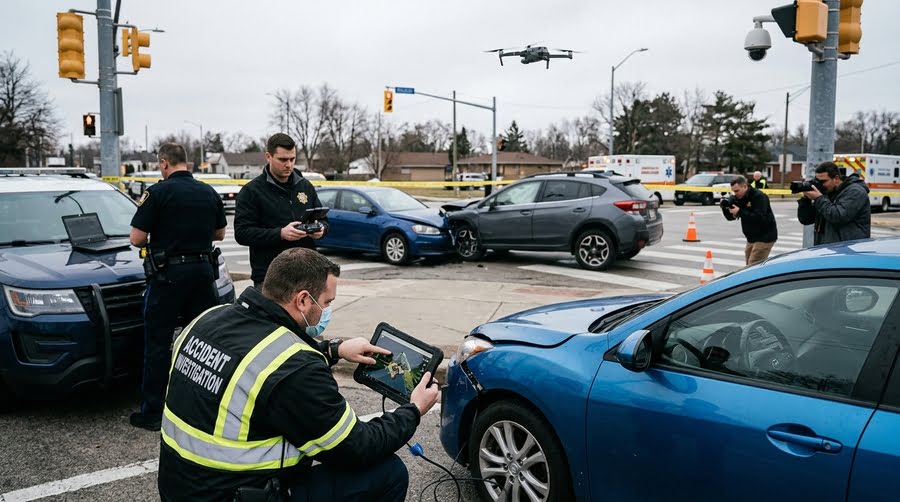
The old accident investigation principle was all about physical evidence, statements, and police observations – that was it. And these methods still remain one of the most important ones, sure, but now investigators have access to much larger amounts of digital evidence, data, and videos.
This has also been noticed by car manufacturers, so modern cars have cameras and connected systems that provide you with information in seconds.
Modern Sources of Digital Evidence
As mentioned above, with the slow appearance of digital evidence, traditional ones had to follow and adapt.
On that note, traditional evidence has been challenged, as digital evidence can help you identify and verify what happened. So, here are some ways of that adaptation mixed with digital evidence that make investigations easier.
Dashcams & Vehicle Black Boxes
Dashcams are a must on pretty much every vehicle. It doesn’t matter whether it’s a traffic incident, or perhaps someone damaged your car while it was in the parking lot, or perhaps someone straight up stole your car – a dashcam can be of tremendous help.
Even if you weren’t directly involved in the accident (e.g., you were just nearby, or a couple of cars behind), your dashcam is still very helpful. They could show whether a car went through a red light, didn’t yield properly, they can show road conditions, the weather, how many participants were involved, any altercation that followed, etc. They’re extremely useful to show what exactly happened. And if the footage is clear and uninterrupted, they’re considered more reliable than eyewitness testimony.
Witnesses are now replaced with dashcams, and they have become the most direct form of evidence.
If you add an Event Data Recorder (EDR) – also known as a vehicle black box – into the mix, then you can recreate pretty much any scenario.
EDRs don’t usually record all the time, but just in a few specific moments. They capture a few moments before, during, and after a crash. And the evidence they provide varies from vehicle speed, brake usage, impact timing, to airbag and seatbelt status.
These generated data, combined with physical evidence, can make the work a lot easier for investigators and for crash victims.
Building an (Accurate Timeline Using Cameras)
Traffic and surveillance cameras are more traditional (more reliable) sources.
And if it weren’t for these ones, A LOT of information would be missed. Also, most of the modern ones have built-in ALPR (Automatic License Plate Recognition) systems, which help pull out extra information on the driver and their movement. This is always handy.
For instance, camera evidence holds a different weight depending on how dense the traffic is. If the accident had happened in a small town, such as Princeton, it would be much easier to find everything about the driver’s movement.
But if the accident occurred in an urban city with dense traffic, it is much harder to figure out where the responsible parties went.
Like, when an accident happens in a city like Chicago:
For an investigator, it becomes much harder to recognize whose fault it was, and if someone has fled the scene, this entire ordeal gets even harder to investigate. Plus, if there happened to be more serious consequences than just a damaged car (e.g., someone got injured), a hit-and-run car accident attorney for Chicago injury victims will also be consulted using a Chicago law firm that specializes in these types of cases, such as Rosenfeld Injury Law.
It’s always best to go with a reputable firm because they usually pack a lot more experience.
What’s more, even though bigger cities have many more public and private cameras operating, it’s also much harder to collect all data from them, and then to also find your suspect.
But, this is where ALPR systems come in use, as they help you identify vehicles across multiple locations; it’s just about finding where those cameras are put.
Connected Vehicles & Digital Data
Another thing that modern cars brought is their ability to function as connected devices.
This is known as V2 technology. And it differs from V2V, which directly connects vehicles, then V2I connects to infrastructure, and V2N to the network.
All this is combined in V2X (Vehicle to Everything), which has found its way to consumer vehicles and is changing everything.
Now, a car has GPS records, not just regular sensors, but they now provide you with all the data about potential risks and future mistakes.
Some are even known to warn drivers about speed limits and bad driving behavior, all telematics data at once.
Conclusion
At the end of the day, no matter how much people are against technology, its development has helped us cross the line between traditional and new, up-to-date evidence.
Of course, not every system or digital data has all the answers, but it most certainly makes the whole process a lot easier and shorter. Nowadays, people also work on introducing vehicle safety technology, AI analysis, and 3D crash reconstructions.
These are going to completely shift the way things used to be done.
Plus, as vehicles keep upgrading and becoming more and more connected to their environment, the digital evidence will play an even greater role in future investigations.