Ford Edge Years to Avoid – Paulette Auto User Review Based Guide
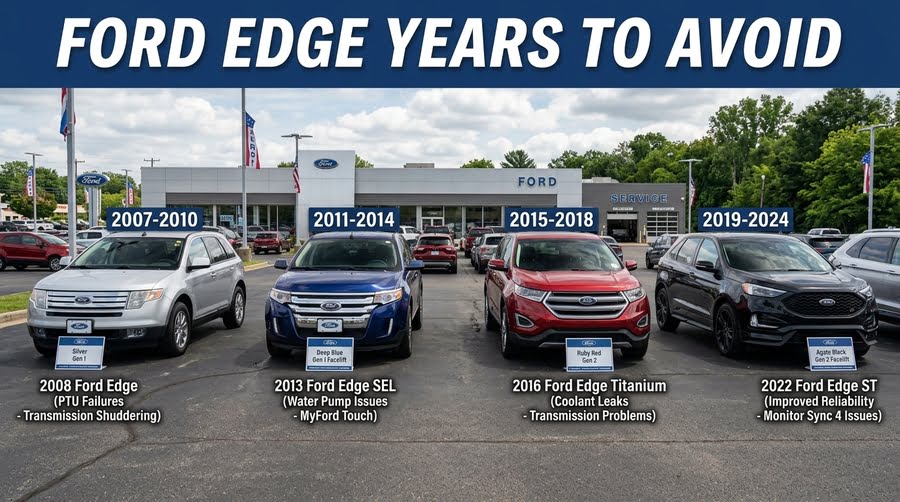
The Ford Edge years to avoid are 2007, 2008, 2011, 2012, 2013, and 2015. These 6 model years account for the highest concentration of transmission failures, engine problems, brake booster defects, and safety recalls across the Ford Edge’s 17-year production run. The 2017 Ford Edge also deserves caution due to expensive engine problems occurring at low mileages.
The Ford Edge entered the midsize crossover market in 2007 and sold over 100,000 units in the United States nearly every year through production. Ford positioned the Edge between the compact Escape and the three-row Explorer, creating a family SUV with more space than the Escape but less bulk than the Explorer. But like most new models, the Edge went through growing pains. The first generation (2007–2014) produced the most complaints, with the 2008 and 2013 models drawing the heaviest criticism. The second generation (2015–2024) started rough with the 2015 model before settling into more reliable territory from 2016 onward.
This guide covers Ford Edge generations and their differences, the specific model years to skip, common Ford Edge problems by system (transmission, brakes, engine, door sensors, airbags, fuel tanks, A/C), real owner complaints, problem counts by year, repair costs, and alternatives for buyers who want a midsize SUV with better reliability. Ford discontinued the Edge after 2024, so the used market is where all shopping happens now.
Ford Edge History and Generations
The Ford Edge debuted in 2006 as a 2007 model year, entering a midsize crossover market that had far fewer options than today. Ford designed the Edge for urban consumers who wanted more room than the Escape but did not need the three-row capacity of the Explorer. The Edge offered seating for five, a sporty ride, and an interior smart enough to compete in a growing segment.
Ford produced the Edge across two generations and two facelifts:
| Generation | Model Years | Engine Options | Transmission | Key Changes |
|---|---|---|---|---|
| 1st Gen (U387) | 2007–2010 | 3.5L V6 | 6-speed automatic | Original launch, FWD and AWD available |
| 1st Gen Facelift | 2011–2014 | 2.0L turbo I4, 3.5L V6, 3.7L V6 | 6-speed automatic | Refreshed styling, turbocharged four-cylinder added |
| 2nd Gen (CD539) | 2015–2018 | 2.0L turbo I4, 2.7L turbo V6, 3.5L V6 | 6-speed automatic | Full redesign, new platform, more power |
| 2nd Gen Facelift | 2019–2024 | 2.0L turbo I4, 2.7L turbo V6 (ST) | 8-speed automatic | 8-speed replaced 6-speed, Co-Pilot360 safety suite standard, ST trim introduced |
Ford discontinued the Edge after the 2024 model year. No replacement is planned.
Ford Edge Generations: Everything You Need To Know In One Place
First Generation (2007–2014) launched with a 3.5-liter V6 and 6-speed automatic. The 2011 facelift added a turbocharged 2.0-liter four-cylinder engine option and refreshed the interior. This generation has the most total complaints of any Edge era, with the 2008 and 2013 models being the worst offenders. The first generation is now 12–19 years old, meaning maintenance costs and aging electrical systems add risk to every purchase.
Second Generation (2015–2024) brought a complete redesign with a new platform, more engine options, and better technology. The 2015 model stumbled out of the gate with engine failures, shattering windows, and electrical problems. The 2019 facelift was the biggest turning point: Ford replaced the 6-speed automatic with an 8-speed automatic, made the Co-Pilot360 safety suite (adaptive cruise, lane-keeping assist, blind-spot monitoring) standard across all trims, and introduced the ST performance trim with a 335-hp 2.7L EcoBoost V6.
The 2019 facelift is the clear dividing line. Everything after 2019 benefits from the 8-speed transmission, modern safety tech, and standard AWD. Everything before 2019 uses older transmission technology and lacks the standard safety features that 2019+ models include.
Which Model Years of Ford Edge Are Safe to Buy Used?
The safest Ford Edge model years to buy used are 2009, 2010, 2014, 2016, and 2019–2024.
2009–2010 Ford Edge — Complaints dropped approximately 90% between the 2008 and 2009 model years. The 2009 Edge had only 3 brake-related complaints (pedal feel preferences, not brake failure). The 2010 model had slightly more concerns, including occasional engine stalling and a faulty brake booster, but problems tended to appear late in the vehicle’s life and were far fewer than 2007–2008.
2014 Ford Edge — The last year of the first generation and one of the most reliable. Only 70 complaints on CarComplaints.com against 2,350+ total for the entire nameplate. J.D. Power awarded the 2014 Edge an 84/100 Quality & Reliability score. The persistent door ajar sensor issue dropped from triple-digit complaints in prior years to single digits for 2014.
2016 Ford Edge — The second year of the second generation smoothed out many 2015 launch problems. Some oil leaks and stalled engines persisted, but complaint volume dropped significantly compared with 2015.
2019–2024 Ford Edge — The post-facelift range delivers the best combination of reliability, safety, and modern features. The 2019 model has only 26 complaints on CarComplaints and a J.D. Power score of 79/100. The 2022 model has just one recall (rearview camera image). For most buyers in 2026, the 2020–2023 range represents the best used value: full access to the 8-speed transmission, Co-Pilot360, reasonable mileage (typically 40,000–80,000 miles / 64,374–128,748 km), and competitive pricing.
If you are comparing the Ford Edge against other Ford SUVs, our Ford Explorer years to avoid and Ford F-150 years to avoid guides cover similar reliability patterns across Ford’s lineup. The Ford Bronco years to avoid is relevant for buyers considering a more rugged alternative.
Ford Edge Model Years to Avoid
Quick Answer: Avoid 2007, 2008, 2011, 2012, 2013, and 2015 Ford Edge Years
The Ford Edge years to avoid are 2007, 2008, 2011, 2012, 2013, and 2015. The 2017 model year also needs caution due to expensive engine problems at low mileages.
The 2007 and 2008 models were plagued by transmission issues, engine problems, and brake failures during the Edge’s first two years of production. Ford likely rushed the Edge to market, given that the better-selling Escape and Explorer had similar or fewer complaints during the same period.
Ford corrected many problems for 2009 and 2010. But the 2011 facelift reintroduced issues: engine power loss, brake failures, transmission problems, and the infamous door ajar sensor defect that believed the passenger door was permanently open. The 2012 model carried the same problems at slightly lower frequency. The 2013 model year is the single worst Ford Edge year by total complaint count (652 complaints on CarComplaints.com), combining engine stalling, brake problems, transmission mishaps, and door sensor malfunctions all in one package.
The second generation started poorly with the 2015 model. Engine failures while driving, windows shattering without impact, water leaking into the cabin, and dead electrical systems made the 2015 Edge the worst start to any Edge generation.
| Model Year | Total Complaints | Main Problems | Severity |
|---|---|---|---|
| 2007 | High | Transmission failure, brake booster, coil packs, roaring rear wheel noise | Severe |
| 2008 | Very High (~200) | 8 recalls, airbag rupture risk, fuel tank leaks, engine/transmission failure | Severe |
| 2011 | Very High (461) | Engine power loss, brake failure, door ajar sensor, A/C failure, body module overheating | Severe |
| 2012 | High | Door ajar sensor, brake pedal issues, transmission problems | Moderate-Severe |
| 2013 | Highest (652) | Engine stalling, door ajar sensor (most complaints), brakes, transmission | Severe |
| 2015 | High | Engine dying while driving, shattering windows, water leaks, electrical system death | Severe |
| 2017 | Moderate (88) | Expensive engine problems at low mileage, 6 recalls, 50/88 complaints engine-related | Expensive |
Owning one of these problem-year Edges creates financial risk beyond just repair bills. Car crashes in the United States result in high costs across medical, legal, and vehicle-replacement categories. A vehicle with known brake booster defects or engine stalling problems increases collision risk, which compounds those costs.
2008 Ford Edge
The 2008 Ford Edge stands out as one of the worst model years in the entire lineup. The National Highway Traffic Safety Administration (NHTSA) issued 8 recalls for the 2008 Edge — two more than the 2007 launch year. The NHTSA posted an “URGENT: DO NOT DRIVE THIS VEHICLE” warning related to rupturing Takata airbag inflators that could spray metal fragments through the cabin at force.
Other 2008 Ford Edge recalls cover leaking fuel tanks and insecure wheels. CarComplaints.com shows nearly 200 complaints. The most reported problems include:
- Transmission shuddering, jerking, slipping, and complete failure
- Power transfer unit (PTU) failing
- Brake booster failure making the pedal extremely hard to press
- Rotors wearing prematurely
- Coil packs burning up
- Loud roaring noise from the rear wheel area
J.D. Power initially awarded the 2008 Edge an 87/100 reliability score, but that score reflects launch-year data. The passing years revealed the 2008 Ford Edge as a used car worth skipping entirely.
2017 Ford Edge
The 2017 Ford Edge logged 6 recalls and 88 complaints, which appears moderate compared with the 2011 or 2013 models. But CarComplaints rates the 2017 as worse than the 2013 because the problems are more expensive and occur at lower mileages.
Of the 88 complaints logged, 50 relate directly to the engine. Engine issues on the 2017 Edge tend to appear earlier in the vehicle’s life than on other model years, meaning even low-mileage examples are not safe from expensive powertrain repairs. The 2017 Ford Edge also had 2017 PTU issues that affected the all-wheel-drive system’s reliability.
CarComplaints states directly: “Although the 2013 Ford Edge has the most overall complaints, we rate the 2017 model year as worse.”
The 2017 model sits in an awkward position: it uses the older 6-speed automatic transmission (no 8-speed until 2019), lacks standard Co-Pilot360 safety features, and carries higher repair risk than 2018 or 2019 models that cost only marginally more on the used market. Skip the 2017 Edge and look at 2019+ models for a better long-term investment.
2011 Ford Edge
The 2011 Ford Edge accumulated 461 complaints and more recalls than the 2013 model (which had higher complaint volume but fewer recalls). The 2011 facelift introduced a refreshed interior and the turbocharged 2.0-liter four-cylinder option, but it also introduced a wave of new problems.
The 2011 Edge issues span nearly every system:
- Engine: Cars losing power or dying while driving. Throttle body failures requiring replacement.
- Brakes: Brake failure reports. Brake booster diaphragm tears causing hard pedal feel and reduced stopping power.
- Transmission: Hiccups, hesitation, and failure.
- Door ajar sensor: The infamous faulty door latch switch that permanently reads the door as open, draining the battery and triggering accidental unlocking.
- A/C system: Overheating around 120,000 miles (193,121 km), blowing hot air in warm weather, requiring cooling fan and timing belt replacement at costs exceeding $1,700.
- Body control module: Failures leading to overheating and fire risk, prompting a recall.
With 461 documented complaints across every major vehicle system, the 2011 Ford Edge is a model year that no used buyer should consider unless the price is extremely low and a full pre-purchase inspection comes back clean.
If you experience an engine stalling incident while driving a problem-year Edge, understanding your next steps matters. What happens if someone else crashes your car covers the insurance implications when a mechanical failure contributes to a collision while another person is behind the wheel.
Which Model Years of Ford Edge Should You Avoid?
To summarize the Ford Edge years to avoid in order of severity:
- 2013 Ford Edge — 652 total complaints (highest of any Edge year). Engine stalling, door ajar sensor (most reported), brakes, transmission.
- 2011 Ford Edge — 461 complaints plus more recalls than 2013. Engine death while driving, brake failure, A/C failure, door sensor, fire risk from body module.
- 2008 Ford Edge — ~200 complaints, 8 recalls, NHTSA “DO NOT DRIVE” warning for airbag inflators.
- 2007 Ford Edge — First model year with pre-2011 transmission failures, brake booster problems, coil packs burning.
- 2015 Ford Edge — Rough second-generation launch. Engine dying while driving, windows shattering spontaneously, water leaks, dead electrical systems.
- 2012 Ford Edge — Door ajar sensor problems, brake pedal issues, transmission concerns (less severe than 2011/2013 but still present).
- 2017 Ford Edge — Fewer total complaints but more expensive and earlier-onset engine problems. 50 of 88 complaints relate to engine.
For buyers considering any used SUV with known issues, proper insurance coverage is non-negotiable. What happens if you have no car insurance and crash explains the legal and financial consequences of driving without coverage, which become worse when you already own a vehicle with documented mechanical risks.
Common Ford Edge Problems
The Ford Edge has 7 primary reliability problems that recur across specific model years and generations.
Faulty A/C Systems
The 2011 Ford Edge A/C system overheats around the 120,000-mile (193,121 km) mark. Symptoms include the A/C blowing hot air or failing completely during warm weather. The fix requires replacing both the cooling fan and timing belt, costing $1,700+ depending on labor rates. This problem appears most frequently in the 2011 model but has been reported in surrounding years.
Faulty Brake Boosters
Brake booster defects affect Ford Edge models from 2007 through 2015, with over 1,000 instances reported by owners. Certain driving conditions cause a tear to develop in the brake booster’s diaphragm. The vehicle produces an abnormal hissing sound when the brake pedal is pressed. As the tear expands, pedal effort increases, and braking capability degrades.
Ford’s official recall states “in all cases, the fundamental vehicle braking system remains functional.” Many owner reviews contradict that claim, with reports of near-miss collisions due to brake pedal hardness. This is one of the most dangerous Ford Edge problems because it directly affects stopping ability.
Defective Fuel Tanks
The 2009–2010 Ford Edge models had fuel tanks that rusted around the tank seam weld, causing fuel leaks. Ford issued a recall, and qualified customers received fuel tank replacements. Check whether any 2009 or 2010 Edge you consider has had the recall completed.
Persistent Door Ajar Light
The 2011, 2012, and 2013 Ford Edge models experience a fault where the door ajar light stays illuminated even with all doors closed. A faulty switch in the door latch mechanism causes the problem. Consequences include:
- Battery drain from the system believing a door is open
- Accidental door unlocking
- Interior lights staying on
- Ongoing annoyance and repair costs of several hundred dollars
The 2013 Ford Edge had the most complaints for this specific problem. The issue dropped to single-digit reports by the 2014 model year.
Clicking Noises from the Wheel Area
Owners of 2007–2014 Ford Edge models report clicking noises from the wheel area beginning around 75,000 miles (120,701 km). Ford technicians typically found nothing structurally wrong with the vehicles but suggested replacing the plastic padding between the wheels as a fix. While not a safety hazard, the noise is persistent and annoying for daily driving.
Transmission Issues
Multiple Ford Edge models struggled with faulty transmissions. The most severe reports describe transmissions stopping while the vehicle is in motion. Other symptoms include:
- Clunking sounds from the transmission
- Illuminated error lights on the dashboard
- Shuddering during acceleration
- Jerking between gears
- Power transfer unit (PTU) failure affecting AWD function
- Transmission slipping
Pre-2019 Ford Edge models use a 6-speed automatic that generated more complaints than the 8-speed automatic introduced with the 2019 facelift. The 2015–2016 models specifically reported transmission shudder and hesitation issues that Ford addressed in later model years.
Faulty Airbags
The 2016–2017 Ford Edge models had malfunctioning airbags that prompted a recall. Owner complaints reported driver airbags either not fully inflating or completely detaching from the assembly during deployment. This is a significant safety issue. The 2008 Ford Edge also carried the broader Takata airbag inflator recall affecting millions of vehicles across many brands.
Run a VIN through NHTSA’s recall lookup before buying any Ford Edge, regardless of model year. Unresolved airbag recalls create life-threatening risk in a collision. Understanding where most car crashes occur in the USA — intersections, highways, and parking lots — reinforces why functioning airbags and brakes are non-negotiable for any vehicle purchase.
Ford Edge Owner Complaints
Real owner complaints illustrate how Ford Edge problems manifest in daily driving. These are representative examples from CarComplaints.com:
Door Ajar Light for 2013 Ford Edge
“Same well reported problem of door ajar light staying on. Battery always going dead. Have tried several fixes but nothing has worked as a permanent solution.” — Bryan S., Satellite Beach, FL
The 2013 Ford Edge received the highest number of door ajar light complaints of any model year. Owners report spending hundreds of dollars on multiple repair attempts without permanent resolution. The battery drain means the car can be dead after sitting overnight.
Engine Problems for 2011 Ford Edge
“Car suddenly would not accelerate and engine ran very rough. Wrench light came up on dash. It would stop if the car was restarted, but would randomly happen again. Throttle body had to be replaced.” — Lori S., Avon, CT
The 2011 Ford Edge engine problems include sudden loss of acceleration, rough running, throttle body failure, and complete engine shutdown while driving. These failures create dangerous situations in traffic. Can you get fired for crashing a company car is a real concern for drivers who experience engine failure in a work vehicle during regular duties.
Back Window Recall for 2016 Ford Edge
“I was driving down the road and heard a loud pop and glass breaking. When I got home I found that the back glass had shattered. I found in Canada that they had a recall for this but not in the US.” — James B., Fort Jennings, OH
The 2015 and 2016 Ford Edge both had reports of rear windows and sunroof glass shattering spontaneously without impact. Canada issued a recall for this problem, but U.S. coverage varied. The 2016 model year improved over 2015 in other areas but retained the window shattering issue.
Brake Pedal/Booster Issue for 2010 Ford Edge
“I almost hit another car, had to let off the pad and hit it again and swerve into the other lane to keep from hitting another car. There needs to be a recall before someone gets killed. Was planning a trip but not going to take this car. It is far too dangerous.” — Shelby P., Fountain Inn, SC
The brake booster defect affects 2007–2015 Ford Edge models. When the diaphragm tears, the brake pedal becomes extremely hard to press, reducing or eliminating normal braking power. This owner’s experience highlights why the brake booster problem is the most dangerous recurring Ford Edge issue.
If a brake failure contributes to a collision while someone else is driving your vehicle, the insurance and liability questions become complicated. What happens if an unlicensed driver crashes your car explains how insurance companies handle these scenarios.
Ford Edge Problem Counts by Year
The complaint distribution across Ford Edge model years shows clear patterns of where problems concentrate:
| Model Year | Generation | Total Complaints | Recalls | Worst Problem Area |
|---|---|---|---|---|
| 2007 | 1st Gen | High | 6 | Transmission, brakes, coil packs |
| 2008 | 1st Gen | ~200 | 8 | Airbags, fuel tank, transmission, engine |
| 2009 | 1st Gen | Low | Moderate | Brake pedal feel (minor) |
| 2010 | 1st Gen | Low-Moderate | Moderate | Brake booster, occasional engine stalling |
| 2011 | 1st Gen Facelift | 461 | High | Engine, brakes, door ajar, A/C, fire risk |
| 2012 | 1st Gen Facelift | Moderate-High | Moderate | Door ajar sensor, brake pedal |
| 2013 | 1st Gen Facelift | 652 (Highest) | Moderate | Door ajar (most reported), engine stalling, brakes |
| 2014 | 1st Gen Facelift | 70 | 3 | Minor (significant improvement) |
| 2015 | 2nd Gen | High | Multiple | Engine death, shattering windows, electrical failure |
| 2016 | 2nd Gen | Moderate | Multiple | Oil leaks, rear windshield, sunroof cracking |
| 2017 | 2nd Gen | 88 | 6 | Engine (50/88 complaints), expensive repairs at low miles |
| 2018 | 2nd Gen | Low | Few | Minor issues |
| 2019 | 2nd Gen Facelift | 26 | 2 | Seatbelt anchor, transmission leak |
| 2020 | 2nd Gen Facelift | Very Low | Few | Minor |
| 2021 | 2nd Gen Facelift | Very Low | Few | Minor |
| 2022 | 2nd Gen Facelift | Very Low | 1 | Rearview camera image |
| 2023 | 2nd Gen Facelift | Very Low | Few | Minor |
| 2024 | 2nd Gen Facelift | Very Low | Few | Minor |
The pattern is clear: first-year and facelift-year models carry the most risk (2007, 2011, 2015), while later years within each cycle improve significantly (2009–2010, 2014, 2016–2018, 2019–2024).
Costly Repairs Associated with Ford Edge Problems
The Ford Edge has an average annual maintenance cost of $611 (RepairPal), but unexpected repairs from documented problems can push costs far higher. RepairPal rates the Ford Edge reliability at 3.5/5, ranking it 11th out of 26 midsize SUVs.
Here are 6 common costly Ford Edge repairs with price ranges:
| Repair | Estimated Cost |
|---|---|
| Transmission fluid change | $427–$451 |
| Engine front cover gasket replacement | $1,698–$2,142 |
| Engine oil cooler replacement | $372–$448 |
| Liftgate pulldown motor replacement | $436–$459 |
| Fuel injector replacement | $391–$475 |
| Airbag clockspring replacement | $284–$300 |
| A/C system repair (2011 specific) | $1,700+ |
| Transmission rebuild/replacement | $2,500–$4,500 |
Repeated issues with electrical systems, brake boosters, and transmission components mean regular shop visits that add hundreds or thousands of dollars to annual ownership costs. The $611 average maintenance figure reflects normal wear items. Problem-year Edges frequently exceed $1,500–$2,500 in annual repair spending.
For buyers comparing ownership costs, understand that a problem-year Edge priced $3,000–$5,000 below a clean 2019+ model often costs more over 2–3 years of ownership once repairs are factored in. The same logic applies if you are comparing a lease versus purchase. Car lease agreements come with a stipulation that you must pay a penalty for excess wear, but leased vehicles are newer and carry warranty coverage that eliminates the repair costs that plague older Edge models.
Alternatives to the Ford Edge for Reliability
If the Ford Edge’s reliability history gives you pause, 5 midsize SUVs offer similar size and utility with stronger dependability records:
| Alternative | Starting Price (New) | RepairPal Score | Key Advantage Over Ford Edge |
|---|---|---|---|
| Honda Passport | $41,100 | 4.0/5 | Higher reliability score, V6 power, Honda Sensing safety |
| Hyundai Santa Fe | $28,750 | 4.0/5 | Lower price, hybrid available, 10-year powertrain warranty |
| Nissan Pathfinder | $35,810 | 3.5/5 | 6,000-lb towing, three rows, strong fuel economy |
| Jeep Grand Cherokee | $40,130 | 3.5/5 | Off-road capability, V6/V8 options, rugged build |
| Kia Telluride | $35,990 | 3.5/5 | Seating for 8, 17 standard safety features, excellent reviews |
Our Honda Passport years to avoid guide helps buyers evaluate the Passport’s reliability by model year. The Jeep Grand Cherokee years to avoid covers similar problem-year analysis for that alternative. For buyers considering a Nissan Rogue as a slightly smaller crossover option, that guide breaks down Nissan’s reliability patterns.
Frequently Asked Questions: Ford Edge Years to Avoid
Q: What are the Ford Edge years to avoid when looking for a used vehicle?
The Ford Edge years to avoid are 2007, 2008, 2011, 2012, 2013, and 2015, with 2017 needing extra caution. These model years have the highest complaint counts and most severe documented problems including transmission failure, engine stalling, brake booster defects, and safety recalls. The 2013 Ford Edge has 652 total complaints (highest of any year), and the 2008 model carries an NHTSA “DO NOT DRIVE” warning related to airbag inflator recalls.
Q: Why should the 2007 and 2008 Ford Edge models be avoided?
The 2007 and 2008 Ford Edge models had widespread transmission, engine, and brake problems during the vehicle’s first two production years. The 2008 model accumulated 8 recalls and nearly 200 complaints. Documented issues include transmission shuddering/failure, power transfer unit failure, brake booster defects, coil packs burning, roaring rear wheel noise, and fuel tank rust leading to leaks. The 2008 Edge also carries the Takata airbag recall with potential for inflator explosion.
Q: What improvements were seen in Ford Edge models after 2015?
From 2016 onward, the Ford Edge showed steady improvement with fewer complaints and less severe issues each year. The 2016 model retained some window-shattering and oil leak reports but at reduced frequency. The 2017 model had expensive engine problems but fewer total complaints. The 2018 model dropped to minimal issues. The 2019 facelift introduced the 8-speed automatic transmission, standard Co-Pilot360 safety suite, and the ST performance trim, creating a much more reliable and modern vehicle. Models from 2019–2024 have the lowest complaint counts in Edge history.
Q: How does the reliability of the Ford Edge vary by generation?
Ford Edge reliability varies by generation with problems concentrating in first-year and facelift-year models across both generations. The first generation (2007–2014) had severe early-year problems (2007–2008) and facelift-year problems (2011–2013), with 2009–2010 and 2014 being the safer picks. The second generation (2015–2024) had a rough launch year (2015) and expensive 2017 engine issues, with 2019–2024 being the strongest reliability range. No Edge generation is entirely free of problems, but choosing the right model year within each generation drastically reduces ownership risk.
Are Ford Edges typically reliable?
The Ford Edge has a mixed reliability record, with a RepairPal score of 3.5/5 (ranking 11th of 26 midsize SUVs). Most problems concentrate in the first generation and early second-generation models. Skip the problem years (2007, 2008, 2011, 2012, 2013, 2015, 2017), and the odds of owning a reliable Edge increase significantly. The 2019–2024 range has proven the most dependable with the fewest complaints per model year.
How much does a used Ford Edge typically cost?
Used Ford Edge pricing ranges from approximately $7,000–$8,000 for a 2008–2010 model to $25,000–$32,000 for a 2020–2023 model. The exact price depends on model year, mileage, trim level (SE, SEL, ST-Line, Titanium, ST), drivetrain (FWD vs. AWD), and condition. A typical 2019 Edge with moderate mileage sells for $18,000–$24,000. CoPilot Price Pulse data shows a typical 2008 Edge at $7,432 and a 2020 Edge at approximately $29,023.
For budget buyers comparing older Edges, car leases under $200 a month with no money down may offer newer vehicles with warranty coverage for similar or lower monthly costs than maintaining a problem-year Edge.
Is the Ford Edge a good car to purchase?
Yes, the Ford Edge is a good car to purchase when you choose from the reliable model years (2009, 2010, 2014, 2016, 2018, 2019–2024). The Edge occupies a practical position in Ford’s SUV lineup: larger and more spacious than the compact Escape but not as large as the three-row Explorer. It offers comfortable seating for five, good cargo space (39.2 cubic feet with rear seats up, 73.4 cubic feet with seats folded), competitive fuel economy, and the 2019+ models include modern safety features as standard equipment. Skip the problem years, and the Ford Edge delivers solid family SUV value.
Summary: No Generation Of Ford Edge Is Safe From Trouble
Every Ford Edge generation has at least one problematic model year. The first generation had the 2007, 2008, 2011, 2012, and 2013 models. The second generation had the 2015 and 2017 models. No generation delivers consistent reliability across every year of production.
The good news: picking the right model year within each generation eliminates most risk. The 2014 Edge is the cleanest first-generation pick. The 2019–2024 range delivers the most reliable second-generation experience with modern transmission technology, standard safety features, and the lowest complaint counts in the vehicle’s history.
Before buying any used Ford Edge:
- Run the VIN through NHTSA’s recall lookup
- Check for completed brake booster, airbag, and fuel tank recalls
- Test all door sensors (open and close each door, verify the light turns off)
- Test-drive for transmission shudder, hesitation, or clunking
- Check for window cracks on sunroof and rear windshield (2015–2016)
- Verify A/C performance at full temperature (2011 models)
- Request complete service history and maintenance records
The Ford Edge was discontinued after 2024, meaning the used market is the only path to ownership. Choose wisely from the safer model years, verify recall completion, and get a pre-purchase inspection from an independent mechanic. A clean 2019+ Ford Edge with service records is a capable, comfortable family SUV that holds up well for daily use.
For buyers who ultimately decide the Ford Edge’s reliability history is too uneven, the Honda CR-V years to avoid and Toyota RAV4 years to avoid guides cover two of the most reliable compact SUV alternatives. If you need something closer to the Edge’s size, the Chevy Equinox years to avoid provides a similar price-point comparison.
If you are involved in a collision with a problem-year Edge or any other vehicle, understanding your rights and next steps matters. The Trey Gowdy car accident and Brittany Johns car incident both demonstrate that accidents happen regardless of vehicle choice. What happens if you crash a rental car and what happens if you crash a leased car cover the financial implications when the vehicle is not fully owned.