Nissan Pathfinder (1995–2023) Firing Order — Diagram & Guide
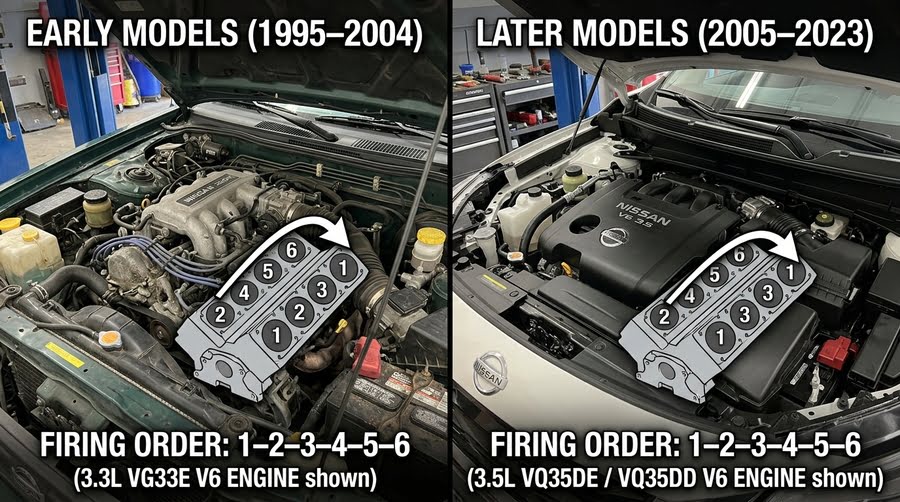
The Nissan Pathfinder firing order depends on the engine: the 4.0L V6 (VQ40DE) uses 1-4-2-5-3-6, the 3.5L V6 (VQ35DE) uses 1-2-3-4-5-6, and the 3.0L V6 (VG30E) used in 1995 models uses 1-2-3-4-5-6. Getting this sequence wrong causes misfires, rough idle, and engine damage.
This guide covers:
- Firing order by engine and model year for all Pathfinder generations (1995–2023)
- Cylinder numbering diagrams for the VG30E, VQ35DE, and VQ40DE engines
- How the OEM 23796-EA20B oil control timing solenoid (OCTS) affects firing order
- Ignition system troubleshooting for common Pathfinder problems
- Spark plug wire removal and replacement procedure
- Tune-up and engine performance check guidance
The Nissan Pathfinder has used 3 main V6 engine families across its production life. Each engine has a specific firing sequence that the camshaft, crankshaft, distributor cap or ignition coils, and spark plugs must follow exactly. A single cylinder out of sequence disrupts combustion timing and converts the engine’s mechanical energy inefficiently — the result is vibration, power loss, and fault codes including p1130, p1140, and p17f0.
Understanding the Nissan Pathfinder Firing Order and the Importance of the OEM 23796-EA20B Oil Control Timing Solenoid
The Nissan Pathfinder firing order for the 4.0L engine is 1-4-2-5-3-6, and this sequence is maintained by the synchronization between the camshaft and crankshaft — a synchronization controlled in part by the OEM 23796-EA20B oil control timing solenoid.
The firing order defines the sequence in which each cylinder completes its combustion stroke. The engine control module (ECM) and ignition system deliver spark to each cylinder at precisely the right moment based on this sequence. When the sequence is correct, the engine runs smoothly and delivers consistent power. When the sequence is disrupted — by a wiring error, a worn distributor, or a faulty timing solenoid — the engine misfires, idles roughly, and loses efficiency.
The OEM 23796-EA20B OCTS controls oil flow to the variable valve timing (VVT) system in the 4.0L VQ40DE engine. This oil flow determines how the camshaft phaser adjusts intake cam timing relative to crankshaft position. When the solenoid fails, the cam timing drifts out of spec — and even though the base firing order (1-4-2-5-3-6) remains correct on paper, the actual spark delivery timing relative to piston position becomes inaccurate. The result is functionally the same as an incorrect firing order: misfires, rough idle, and reduced performance.
The 23796-EA20B solenoid fits the Nissan Pathfinder 4.0L, Nissan Frontier 4.0L, Nissan Xterra 4.0L, Nissan Quest, NV1500, NV2500, and NV3500 — any Nissan platform using the VQ40DE engine shares this component.
Firing Order
Nissan Pathfinder firing order by engine and model year:
| Engine | Displacement | Model Years | Firing Order | Ignition Type |
|---|---|---|---|---|
| VG30E | 3.0L V6 (2960cc) | 1995–1995 | 1-2-3-4-5-6 | Distributor |
| VG33E | 3.3L V6 | 1996–2004 | 1-2-3-4-5-6 | Distributor |
| VQ35DE | 3.5L V6 | 2005–2012 | 1-2-3-4-5-6 | Coil-on-plug |
| VQ40DE | 4.0L V6 | 2005–2023 | 1-4-2-5-3-6 | Coil-on-plug |
The 1995 Nissan Pathfinder 2WD V6-2960cc 3.0L SOHC MFI (VG30E) uses firing order 1-2-3-4-5-6 as documented in the Operation CHARM service manual for Nissan-Datsun vehicles. This is the factory specification confirmed in the Pathfinder 2WD V6-2960cc 3.0L SOHC MFI (VG30E) repair documentation.
Cylinder numbering — VG30E and VG33E (1995–2004):
The VG30E and VG33E are V6 engines with 2 banks of 3 cylinders each. Cylinders are numbered as follows:
- Front bank (passenger side): Cylinders 1, 2, 3 — numbered front to rear
- Rear bank (driver side): Cylinders 4, 5, 6 — numbered front to rear
The distributor cap on these engines has 6 terminals. Terminal positions correspond to the firing order 1-2-3-4-5-6 in a clockwise rotation when viewed from above.
VG30E / VG33E Cylinder Layout (top view)

FRONT OF ENGINE
  [1] [2] [3]   ← Passenger side bank
  [4] [5] [6]   ← Driver side bank
REAR OF ENGINE

Firing Order: 1 → 2 → 3 → 4 → 5 → 6
Cylinder numbering — VQ35DE and VQ40DE (2005–2023):
The VQ35DE and VQ40DE are also V6 engines but use coil-on-plug ignition — no distributor cap. Cylinder numbering follows this layout:
- Bank 1 (right side / passenger side when installed): Cylinders 1, 3, 5
- Bank 2 (left side / driver side when installed): Cylinders 2, 4, 6
VQ40DE Cylinder Layout (top view)

FRONT OF ENGINE
  [1] [3] [5]   ← Bank 1 (passenger side)
  [2] [4] [6]   ← Bank 2 (driver side)
REAR OF ENGINE

Firing Order: 1 → 4 → 2 → 5 → 3 → 6
Firing order by specific model year:
- 1995 Pathfinder 3.0L (VG30E): 1-2-3-4-5-6 (distributor)
- 1996–2004 Pathfinder 3.3L (VG33E): 1-2-3-4-5-6 (distributor)
- 2001–2004 Pathfinder 3.5L (VQ35DE): 1-2-3-4-5-6 (coil-on-plug)
- 2005–2012 Pathfinder 4.0L (VQ40DE): 1-4-2-5-3-6 (coil-on-plug)
- 2005–2012 Pathfinder 3.5L (VQ35DE): 1-2-3-4-5-6 (coil-on-plug)
- 2013–2023 Pathfinder 3.5L (VQ35DE): 1-2-3-4-5-6 (coil-on-plug)
The 2006 Nissan Xterra and 2008 Nissan 4.0L engine share the VQ40DE with the Pathfinder 4.0L — the firing order 1-4-2-5-3-6 applies to all of these. Owners searching for the 2005, 2006, 2007, 2008, 2009, 2010, 2011, or 2012 Nissan Pathfinder firing order on the 4.0L engine use this same sequence.
The 2013–2023 Pathfinder switched back to the 3.5L VQ35DE exclusively. The firing order for these model years is 1-2-3-4-5-6.
How to locate cylinder 1:
On the VG30E (1995 Pathfinder), cylinder 1 is at the front of the passenger-side bank. Confirm cylinder 1 location before routing spark plug wires — wiring cylinder 2 to the cylinder 1 position on the distributor cap produces an immediate misfire.
On the VQ40DE (2005–2012 Pathfinder 4.0L), cylinder 1 is at the front of Bank 1 (passenger side). Coil packs are labeled by cylinder number and mount directly to the spark plug — there are no wires to route between coil and plug.
Ignition System Troubleshooting
Common Issues and Solutions
Nissan Pathfinder ignition system problems cluster around 4 failure modes depending on engine generation:
1. Distributor-based systems (VG30E, VG33E — 1995–2004):
The distributor cap and rotor are the most common failure points. A cracked distributor cap allows moisture in and produces cylinder-specific misfires. The rotor tip wears over time and reduces spark energy to the affected cylinder.
Symptoms of distributor cap failure:
- Single-cylinder misfire at idle that worsens in wet weather
- Engine stumble at low RPM
- Difficulty starting when cold
Fix: Replace the distributor cap and rotor as a set. When reinstalling spark plug wires, route each wire to the correct cap terminal using the firing order 1-2-3-4-5-6. Mark each wire before removal to avoid cross-wiring.
2. Coil-on-plug systems (VQ35DE, VQ40DE — 2005–2023):
Coil-on-plug (COP) systems eliminate spark plug wires but introduce individual coil pack failures. A failed coil pack produces a single-cylinder misfire code.
Symptoms of coil pack failure:
- Check engine light with misfire code (P0301 through P0306)
- Engine vibration at idle
- Hesitation during acceleration
Fix: Swap the suspect coil pack to a different cylinder. If the misfire code follows the coil to the new cylinder, the coil is the cause — replace with a coil pack matched to the Pathfinder’s specific engine.
3. VVT system faults affecting apparent firing order (VQ40DE — 4.0L):
Fault codes p1130 and p1140 on the Nissan Pathfinder indicate bank 1 and bank 2 air-fuel ratio sensor issues that are frequently triggered by a failing OEM 23796-EA20B OCTS. When the solenoid fails to regulate oil pressure to the intake cam phaser correctly, the cam timing retards or advances beyond specification. This creates a condition where actual combustion timing no longer matches the ECM’s programmed ignition timing map — producing the same symptoms as incorrect firing order without any wiring fault.
Fault code p17f0 on the 2013 Pathfinder specifically relates to VVT system operation and is another indicator of OCTS degradation.
4. Timing chain wear (VG33E — 1996–2004):
Stretched timing chains on high-mileage VG33E engines shift cam timing relative to crankshaft position. The firing order remains 1-2-3-4-5-6 in the wiring, but actual combustion occurs at incorrect crank angles. Symptoms include rough idle at cold start that clears when warm, rattling from the timing chain cover on startup, and reduced fuel economy.
Fix: Replace the timing chain, guides, and tensioner as a set. Verify timing marks on the crankshaft sprocket and camshaft sprocket align with factory specifications before final assembly.
Diagnostic steps for any Pathfinder ignition fault:
- Connect a scan tool and read all stored fault codes before clearing
- Identify the misfiring cylinder from the P030X code (X = cylinder number)
- Swap the coil pack (COP engines) or check the distributor cap terminal (distributor engines) for the affected cylinder
- Check spark plug condition — carbon fouling indicates rich mixture; white deposits indicate lean mixture or overheating
- Perform a compression test if the misfire persists after coil and plug replacement
- Check the timing chain cover for oil residue indicating chain wear on VG30E and VG33E engines
- Test the OEM 23796-EA20B OCTS resistance and operation on VQ40DE engines with p1130, p1140, or p17f0 codes
Community Discussions and Expert Advice
AnhTuan posted on the Nissan Pathfinders forum in July 2010 asking for help with the ignition system on a 1987 Nissan Pathfinder with the VG30i engine, specifically requesting the cylinder layout and firing order. The VG30i is the fuel-injected predecessor to the VG30E — the firing order is 1-2-3-4-5-6 and the cylinder layout matches the VG30E description above.
This type of question appears repeatedly across Pathfinder owner forums because the firing order varies between the 3.0L/3.3L distributor engines and the 4.0L coil-on-plug engine. Owners working on a 2008 Nissan 4.0L often search separately from those working on a 1995–2004 model — and the correct answers are genuinely different.
The Operation CHARM service manual database documents the firing order for the 1995 Pathfinder 2WD V6-2960cc 3.0L SOHC MFI (VG30E) under the Tune-up and Engine Performance Checks section. LEMON (lemon-manuals.la) is the successor platform to Operation CHARM and contains all CHARM manuals plus newer documentation through 2025.
Key forum-confirmed firing order data:
- 1995–2004 Pathfinder VG30E/VG33E: 1-2-3-4-5-6 confirmed in Operation CHARM manual
- 2005–2012 Pathfinder VQ40DE 4.0L: 1-4-2-5-3-6 confirmed by multiple 2006 Xterra and 2008 Pathfinder 4.0L owners
- 2005–2023 Pathfinder VQ35DE 3.5L: 1-2-3-4-5-6 confirmed in Nissan factory service documentation
OEM 23796-EA20B Oil Control Timing Solenoid
Role and Importance
The OEM 23796-EA20B oil control timing solenoid controls oil pressure to the VVT system in the Nissan Pathfinder 4.0L VQ40DE engine, and a failed solenoid directly disrupts the camshaft-to-crankshaft synchronization that maintains the 1-4-2-5-3-6 firing sequence.
The solenoid operates as an electronically controlled valve. The ECM sends a pulse-width modulated (PWM) signal to the solenoid, which opens and closes rapidly to regulate oil pressure to the intake cam phaser. Higher oil pressure advances intake cam timing; lower pressure retards it. This variable cam timing adjusts combustion efficiency across the RPM range — advancing timing at low RPM for torque and retarding at high RPM for power.
When the solenoid sticks open, oil pressure over-advances the cam. When it sticks closed, the cam sits at maximum retard. Either condition produces misfires and fault codes because the ECM’s ignition timing tables assume the cam is at the correct position.
The 23796-EA20B solenoid fits the following Nissan vehicles with 4.0L VQ40DE engines:
- Nissan Pathfinder 4.0L
- Nissan Frontier 4.0L
- Nissan Xterra 4.0L
- Nissan Quest
- NV1500, NV2500, NV3500
Signs of a failing 23796-EA20B solenoid — 5 documented symptoms:
- Engine misfire at idle — particularly cylinder 1 or cylinder 4, the first 2 cylinders in the 1-4-2-5-3-6 sequence, because Bank 1 cam timing affects these cylinders most directly
- Rough idle that clears at higher RPM — the ECM compensates better at higher oil pressure
- Check engine light with p1130 or p1140 — Bank 1 or Bank 2 air-fuel ratio sensor rationality codes triggered by cam timing deviation
- p17f0 code on 2013 Pathfinder — VVT system performance fault directly linked to solenoid operation
- Reduced fuel economy — cam timing held at retard increases fuel consumption
Use a diagnostic scanner to read fault codes before replacing the solenoid. P0010 (intake camshaft position actuator circuit, Bank 1) and P0020 (Bank 2) directly implicate the solenoid and its wiring.
Installation and Maintenance
To replace the OEM 23796-EA20B oil control timing solenoid on a Nissan Pathfinder 4.0L, follow these 5 steps:
- Disconnect the battery — disconnect the negative terminal first. This prevents ECM voltage spikes during solenoid connector removal and clears any adaptive fuel trim data that accumulated during the fault period.
- Locate the solenoid — the 23796-EA20B sits on the front of the engine near the timing chain cover, on the passenger side (Bank 1) and driver side (Bank 2) depending on which unit is being replaced. Consult the Nissan service manual or the Operation CHARM/LEMON database for the specific location on your model year.
- Remove the old solenoid — disconnect the electrical connector. Remove the single retaining bolt (typically 10 mm). Pull the solenoid straight out — a small amount of engine oil will drain from the bore, so have a rag ready.
- Install the new OEM 23796-EA20B solenoid — lubricate the O-ring with clean engine oil before insertion. Insert the solenoid straight into the bore and hand-tighten the retaining bolt first, then torque to specification (approximately 7.2–9.4 ft-lbs / 9.8–12.7 N·m — confirm in the Nissan service manual for your specific model year).
- Reconnect the battery and test — start the engine and allow it to reach operating temperature. Use a scan tool to confirm fault codes are cleared and do not return. Check for oil leaks at the solenoid O-ring seal.
Maintenance interval: The 23796-EA20B solenoid has no scheduled replacement interval. Replace it when fault codes p0010, p0020, p1130, p1140, or p17f0 appear and wiring inspection rules out a harness fault. Using OEM parts ensures the O-ring dimensions and solenoid flow characteristics match the VQ40DE’s oil pressure specifications — aftermarket units vary in flow rates and may not clear the fault codes reliably.
Timing verification after solenoid replacement:
After installing the new solenoid, verify the firing order is maintained by confirming the following:
- Use a timing light to check ignition timing at idle against the specification in the Nissan service manual
- Confirm the crankshaft position sensor (CKP) and camshaft position sensor (CMP) signals are in correct phase relationship using a scan tool with live data
- Check that the VVT advance angle at idle and at 3,000 RPM matches the factory specification — typically 0° at idle and 20–30° advance at 3,000 RPM on the VQ40DE
- Clear all fault codes and perform a drive cycle to confirm no codes return
Related Resources
Tune-up and Engine Performance Checks
The firing order verification belongs within a broader engine performance check for the Nissan Pathfinder. A complete tune-up on a Pathfinder covers 6 main items:
- Spark plug replacement — replace at the interval specified by Nissan (typically 30,000 miles / 48,000 km for standard plugs or 105,000 miles / 169,000 km for iridium plugs on VQ engines). Use the correct plug gap — 0.039–0.043 inches (1.0–1.1 mm) for the VQ40DE. Incorrect gap affects combustion completeness and apparent misfire.
- Distributor cap and rotor (1995–2004 VG30E/VG33E only) — inspect the distributor cap for cracks, carbon tracking between terminals, and corroded contacts. Replace the rotor if the tip shows more than 0.5 mm (0.02 inches) of wear.
- Ignition coil inspection (2005–2023 VQ35DE/VQ40DE) — measure primary and secondary resistance on each coil pack. Primary resistance: 0.5–0.7 ohms. Secondary resistance: 8,000–12,000 ohms. Replace any coil outside this range.
- Timing chain inspection (VG30E/VG33E) — listen for chain rattle on cold start. Excessive slack in the timing chain produces a rattle from the timing chain cover that disappears after 30 seconds as oil pressure builds. Replace the chain if slack exceeds factory specification.
- Air filter — a restricted air filter leans the mixture and can produce fault codes that mimic ignition faults, including p1130 and p1140.
- Throttle body cleaning — carbon buildup on the throttle plate causes erratic idle that mimics ignition misfires on Pathfinders with the VQ35DE and VQ40DE engines.
The Operation CHARM service manual documents the full tune-up procedure for the 1995 Pathfinder 2WD V6-2960cc 3.0L SOHC MFI (VG30E) under Repair and Diagnosis > Maintenance > Tune-up and Engine Performance Checks. The LEMON platform successor database covers 1995 through 2025 model year manuals.
Spark Plug Wire Removal and Replacement
Spark plug wire replacement applies to 1995–2004 Pathfinder models with the VG30E and VG33E distributor-based ignition systems. The 2005–2023 models with VQ35DE and VQ40DE coil-on-plug systems do not use spark plug wires — individual coil packs connect directly to each spark plug.
Spark plug wire replacement procedure for VG30E/VG33E (1995–2004 Pathfinder):
- Label each wire before removal — use masking tape and a marker to label each wire with its cylinder number (1 through 6) before pulling any wire off the distributor cap. This is the single most important step — installing a wire on the wrong distributor cap terminal changes the effective firing sequence and produces an immediate misfire.
- Remove wires one at a time — grip the boot (not the wire itself) and twist while pulling straight off the spark plug. Pulling the wire instead of the boot tears the wire from the boot and destroys the wire.
- Inspect the spark plug — while the plug is accessible, check the electrode condition. Carbon fouling indicates rich mixture; white or gray deposits indicate lean mixture or detonation. Replace plugs outside of normal tan/light brown coloring.
- Apply dielectric grease to the new wire boots — a small amount of dielectric grease inside each boot prevents the boot from bonding to the plug ceramic and makes future removal easier.
- Route new wires in original positions — route each wire through the factory wire separators and brackets to prevent wires from contacting hot exhaust components or rotating parts. Cross-routed wires can cause electrical interference (inductive crossfire) that produces misfires on adjacent cylinders.
- Verify distributor cap terminal positions — connect each wire to the correct distributor cap terminal using the firing order 1-2-3-4-5-6 in clockwise rotation. Cylinder 1 wire connects to the terminal directly above the rotor’s position when cylinder 1 is at top dead center (TDC) on the compression stroke.
- Start the engine and check for smooth idle — a smooth idle with no misfire confirms correct wire routing. A rough idle or misfire immediately after wire replacement indicates at least one wire is connected to the wrong terminal.
Wire resistance specification for VG30E/VG33E spark plug wires: Maximum resistance is 25,000 ohms per wire (25 kΩ). Measure resistance with a multimeter from the distributor cap terminal to the spark plug boot. Replace any wire exceeding this value — high resistance reduces spark energy and produces intermittent misfires.
The Nissan Pathfinder firing order — 1-2-3-4-5-6 for the 3.0L VG30E and 3.3L VG33E and 1-4-2-5-3-6 for the 4.0L VQ40DE — is the starting point for diagnosing any ignition, misfire, or timing fault on these engines. Verify the correct firing order for your specific model year before performing any ignition work, and use the OEM 23796-EA20B oil control timing solenoid on 4.0L VQ40DE engines to maintain the camshaft-to-crankshaft synchronization that keeps the ignition timing accurate across all operating conditions.